7 Tips for Choosing a Reliable Emergency Locksmith
Find a trustworthy emergency locksmith with our 7 essential tips. Learn how to verify credentials, spot scams, and get fair pricing for lockout services.
Table of Contents
- Verify Professional Credentials and Licensing
- Request Identification and Check for Bonded and Insured Status
- Understand Emergency Locksmith Cost Estimates Before Service
- Read Reviews and Check for Third-Party Accreditation
- Recognize Signs of a Locksmith Scam
- Confirm Service Guarantees and Response Time Commitments
- Local Emergency Locksmith Services and Coverage Areas
- Frequently Asked Questions
Last Updated: August 28, 2026
When you're locked out at 2 a.m. or your car key stops working, the stakes are high, and so is the risk of getting scammed. An emergency locksmith can solve your problem in minutes, but choosing the wrong one means overpaying, dealing with damage to your property, or worse, inviting security vulnerabilities into your home. At Lock it All Locksmithing, we've helped many customers navigate this decision, and we've seen the red flags that separate legitimate professionals from opportunists.
The difference between a trustworthy emergency locksmith and a predatory one often comes down to a few critical checks you can do before they even arrive. This guide walks you through exactly what to verify, what questions to ask, and how to spot the warning signs that should send you looking elsewhere.
Verify Professional Credentials and Licensing
The first step in choosing a reliable emergency locksmith is confirming they're actually licensed to do the work. Licensing requirements vary by state, but legitimate locksmiths carry credentials that prove they've met professional standards and passed background checks (ncsl.org). Before you hire anyone, ask for their license number and verify it with your state's licensing board or regulatory agency.
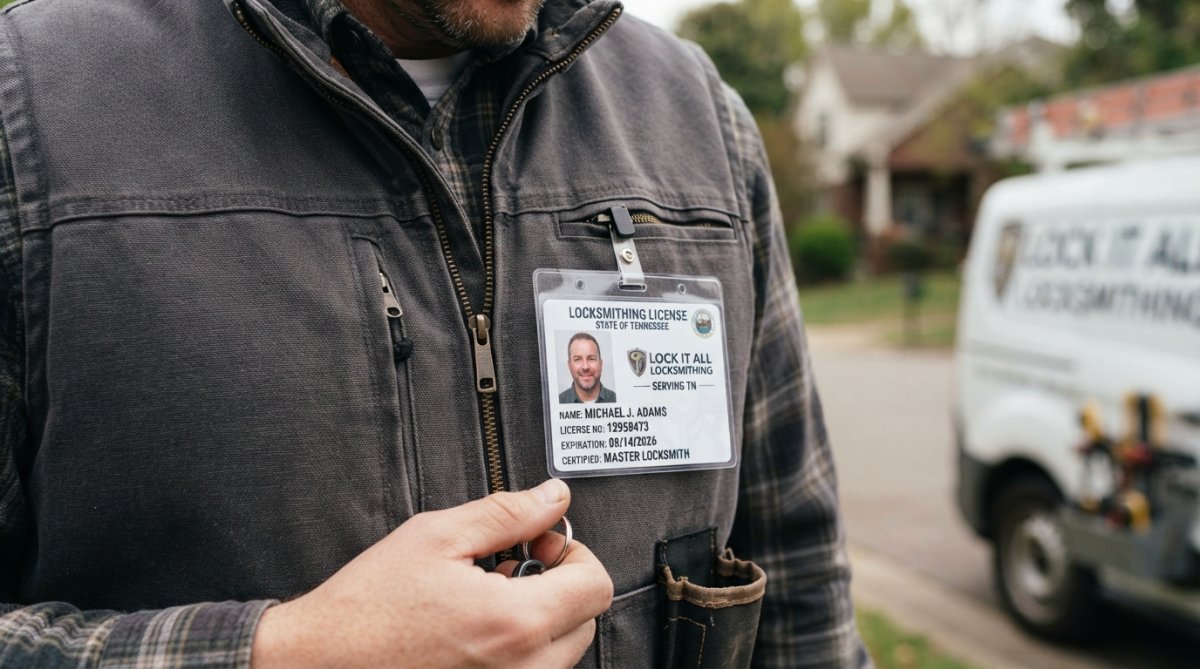
A licensed locksmith has invested time and money into their profession through apprenticeships, exams, and ongoing training. When you call an emergency locksmith service, ask directly: "Are you licensed in this state?" If they hesitate or claim licensing isn't necessary, that's a major red flag.
Beyond state licensing, look for additional certifications from professional organizations like the Associated Locksmiths of America (ALOA), which indicate commitment to industry standards and expertise beyond minimum legal requirements.
Request Identification and Check for Bonded and Insured Status
When the locksmith arrives at your door, ask to see a photo ID and proof that they work for the company you called. This prevents impersonation scams where someone claims to be from a legitimate service but isn't actually affiliated with them.
Confirm that the emergency locksmith company carries liability insurance and is bonded. Insurance protects you if they accidentally damage your door, frame, or locks during the job (iii.org). A bond provides additional financial recourse if something goes wrong. Call the company's main office and ask directly: "Are your technicians bonded and insured? Can you provide proof?" A reputable service will have this documentation ready.
Understand Emergency Locksmith Cost Estimates Before Service
One of the biggest complaints about emergency locksmith services is surprise pricing. Before any work begins, ask the locksmith for a written estimate that includes the service call fee, labor rate, parts costs, and any trip charges. If they refuse to provide an estimate or give you a vague range, that's a red flag.
Many emergency locksmith services charge differently based on the time of day (bls.gov). Late-night calls, weekend service, or holiday work typically costs more than standard business hours. This is normal and reasonable, but the markup should be reasonable. If a simple lockout costs $150 during the day but $400 at night, ask why.
Ask about their service call fee separately from labor. Some companies charge $50-75 just to show up and assess the situation; others include this in their labor rate. If the locksmith completes the job, the service call fee should apply toward the total. Digital payment is standard for professional services; they should accept credit cards, not demand cash only.
Read Reviews and Check for Third-Party Accreditation
Before calling an emergency locksmith, spend 10 minutes reading reviews on Google, Yelp, Better Business Bureau, and local directories. Look for patterns in customer feedback, not just individual comments. Multiple complaints about the same issue, overcharging, damage, rudeness, indicate a pattern worth avoiding.
Pay attention to how recent the reviews are. Current reviews are more reliable indicators of current service quality than older feedback. The Better Business Bureau maintains records of complaints and resolutions; a company with a solid BBB rating demonstrates accountability.
Read reviews critically for specific details: "They arrived on time," "Fixed my deadbolt without damaging the frame," "Charged exactly what they quoted." These specifics are more credible than generic praise. Ask the emergency locksmith company for references and call one or two to ask specific questions about their experience.
Recognize Signs of a Locksmith Scam
Scammers targeting people in lockout situations use specific tactics. Knowing these patterns helps you spot and avoid them before you hand over money.
Bait-and-switch pricing is the most common scam. An ad promises "$29 lockout service," but when the locksmith arrives, they claim your lock is "too complex" and suddenly the price jumps to $300+. Legitimate emergency locksmith services don't operate this way.
Cash-only demands are another red flag. Scammers want cash because it's untraceable. Professional emergency locksmith services accept credit cards and provide receipts.
Unnecessary services are a sign of predatory pricing. A scammer might recommend replacing your entire lock when rekeying would work. Before agreeing to anything beyond your original request, ask why it's necessary.
Vague or no written estimates should make you suspicious. Professional services provide itemized quotes before work begins.
Aggressive upselling during the job is manipulative. While legitimate services do offer additional services, the hard sell during an emergency is a warning sign.
No company identification is a dealbreaker. Legitimate services arrive in branded vehicles with company logos, uniforms with their name, and professional ID.
Confirm Service Guarantees and Response Time Commitments
A reliable emergency locksmith service stands behind their work. Ask what guarantee they offer; many professionals guarantee their work for 30 days, if the lock fails or the key doesn't work properly within that window, they'll fix it at no charge.
Response time is critical for emergency locksmith services. Ask the company: "What's your average response time?" Professional operations in urban areas typically arrive within 30-45 minutes. If a company promises 15 minutes everywhere, they're not being realistic.
Some services offer pricing guarantees or satisfaction guarantees. Ask about their cancellation policy; legitimate services usually waive or reduce the fee if you cancel before they're en route.
Local Emergency Locksmith Services and Coverage Areas
Choosing a local emergency locksmith service has advantages over national call centers. Local businesses typically have technicians stationed throughout the area, which means faster response times and long-term community investment.
When you search for an emergency locksmith, include your city or neighborhood in the search. Call a few and ask: "How many technicians do you have in this area? Where are you located?" Local operations can answer these questions specifically.
Verify that the company actually operates in your area before you're in an emergency situation. Some services advertise broadly online but only cover certain neighborhoods.
Lock it All Locksmithing serves the greater Nashville area and provides emergency locksmith services across Tennessee. We maintain technicians throughout the region to ensure rapid response times. When you call our team, you're reaching a local business with deep roots in the community, not a national call center.
Choosing a reliable emergency locksmith comes down to verification, transparency, and trust. Before you're in a lockout crisis, identify local services, verify their credentials, and understand their pricing structure.
If you need professional emergency locksmith services in Tennessee, Lock it All Locksmithing is ready to help. Our team provides transparent pricing, rapid response, and expert service for residential, automotive, and commercial lockouts. Call us at 615-810-7304 for immediate assistance or to schedule a consultation.
| Verification Step | What to Check | Red Flags |
|---|---|---|
| Credentials | State license, ALOA certification | No license, deflects when asked |
| Insurance & Bonding | Proof of liability coverage and bond | Claims not necessary, can't provide documentation |
| Estimate | Written breakdown before work begins | Vague pricing, refuses to estimate |
| Reviews | Recent feedback on Google, Yelp, BBB | Mostly negative, complaints about overcharging |
| Identification | Photo ID, company uniform, branded vehicle | Unmarked vehicle, no ID, can't verify identity |
| Pricing Transparency | Clear service call fee, labor rate, parts | Bait-and-switch, cash-only demand, hidden charges |
| Service Guarantee | Warranty on work, response time commitment | No guarantee, unrealistic response promises |
| Local Presence | Technicians in your area, realistic arrival time | National call center, 2+ hour wait times |
Frequently Asked Questions
Q: How do I know if an emergency locksmith is reputable?
A: A reputable emergency locksmith will provide verifiable credentials, maintain bonded and insured status, and offer transparent pricing before starting work. Check for customer testimonials, third-party accreditation, and a physical business address. Ask for identification when they arrive, and verify their licensing with your state's regulatory board. Avoid any technician who refuses to provide an on-site estimate or pressures you to pay before service completion.
Q: What should I expect to pay for an emergency locksmith cost estimate?
A: Emergency locksmith pricing depends on the type of service, time of day, and your location. Most services include a call-out fee for arriving at your location, plus labor charges for the actual work. Reputable locksmiths provide a detailed estimate before beginning service. Get quotes from multiple providers to understand fair market rates. Avoid any provider who quotes prices over the phone without assessing your specific situation, as this is a common scam tactic.
Q: What are the main signs of a locksmith scam?
A: Red flags include refusing to provide identification, quoting prices only by phone without seeing the lock, demanding cash-only payment, or claiming they need to drill your lock when non-destructive methods exist. Scam operators often use generic business names, have no verifiable online presence, and pressure you into immediate payment. They may also claim your locks are damaged beyond repair to justify expensive replacements. Always request a written estimate and verify their business license before allowing them access to your home.
Q: Are there specific certifications I should look for in a locksmith?
A: Look for locksmiths who hold certifications from recognized organizations like the Associated Locksmiths of America (ALOA) or the Automotive Locksmiths Association (ALA). These certifications indicate the technician has completed training and passed exams in their field. Additionally, verify that your locksmith holds a valid state license, maintains professional liability insurance, and is bonded. Ask about their experience with your specific type of lock or service need, whether automotive, residential, or commercial.
Why Nashville drivers choose Lock it All Locksmithing
We are a locally owned, licensed and insured mobile locksmith serving Nashville and the surrounding Middle Tennessee communities. You speak directly with the technician who does the work, get an honest price before we dispatch, and we arrive in a fully stocked service vehicle so most jobs finish in a single visit — usually within 20 to 45 minutes of arriving. No towing, no dealership appointment, no surprise fees.
How the visit works
- Tell us the details: call, text or send the quote form with your vehicle's year, make and model, or a description of your lock problem.
- Get an exact price: we quote parts, cutting, programming and travel up front.
- We come to you: our mobile workshop meets you at home, work or roadside.
- Done on the spot: keys are cut, programmed and tested with you before we leave.
Areas we serve
Nashville, Murfreesboro, Franklin, Hendersonville, Smyrna, La Vergne, Antioch, Brentwood, Mount Juliet, Lebanon and the surrounding towns across Middle Tennessee.
What our customers say
- "Fast, professional and honest — had a new key for my truck programmed in under half an hour." — Adrian Fiorito, 5 stars.
- "Great service and fair pricing. Came out same day and solved the problem right away." — George Yacoub, 5 stars.
- "Very knowledgeable and friendly. Highly recommend for anyone needing a locksmith in Nashville." — Jan Daoud, 5 stars.
Rated 5 stars across 100+ verified Google reviews. Call or text 615-810-7304 or email info@lia-locksmith.com.