Cybersecurity Best Practices for Connected Fleet Vehicles
Protect your connected fleet with proven cybersecurity best practices. Learn how to secure telematics, software updates, and vendor access.
Last Updated: October 31, 2026
Quick Summary
Secure a connected fleet by inventorying every connected device, enforcing multi-factor authentication on all fleet platforms, and keeping firmware current against vendor bulletins. Add a written policy with named ownership, vendor security terms, and an incident response plan that defines who can ground a vehicle.
- Run a quarterly checklist covering device inventory, MFA, firmware versions, permissions, fob revocation, and vendor access logs.
- Require signed over-the-air updates, schedule them during downtime, and keep a rollback plan per vehicle.
- Build a five-phase incident response playbook: detect and triage, contain, preserve evidence, notify, recover and verify.
- Score seven control areas on a five-level maturity scale and prioritize fixes by risk exposure times ease of fix.
- Start this month by inventorying connected devices, enabling multi-factor authentication, and changing every default password.
Table of Contents
- Why Cybersecurity Matters for Connected Fleet Vehicles
- Fleet Vehicle Cybersecurity Risks: Attack Vectors and Threat Landscape
- Building Your Vehicle Cybersecurity Checklist
- Creating a Fleet Cybersecurity Policy Template
- Securing the Connected Fleet: Governance, Vendors, and EV Charging
- Developing a Connected Vehicle Incident Response Plan
- Fleet Cybersecurity Metrics and Maturity Assessment
- Privacy, Data Retention, and Employee Monitoring
- Next Steps for Securing Your Fleet Vehicles
- Frequently Asked Questions
Why Cybersecurity Matters for Connected Fleet Vehicles
A connected fleet is a group of vehicles that exchange data with telematics units, mobile apps, and cloud platforms over wireless networks. Every one of those connections is a door, and most fleets leave several of them unlocked. This guide from Lock it All Locksmithing covers the practical controls that close them.
The stakes are higher than most managers assume. A modern work truck is a computer network on wheels: it holds location history, driver credentials, camera footage, and a cellular link to your dispatch software. Compromise one vehicle and an attacker can reach the whole fleet management platform. Ransomware crews have learned that a halted fleet costs more per hour than a locked office.
Vehicle cybersecurity is often treated as an IT problem and handed to the help desk. But the attack surface starts at the key fob, the OBD-II port, and the aftermarket device a driver plugged in last week. Physical and digital security are the same job now.
Below, we break down the threats, the checklist, and the policies that hold up when something goes wrong.
Fleet Vehicle Cybersecurity Risks: Attack Vectors and Threat Landscape
Fleet vehicle cybersecurity risks fall into four groups: remote attacks over cellular and Wi-Fi links, physical access through ports and keys, supply-chain exposure through vendors, and human error. Most incidents combine at least two.
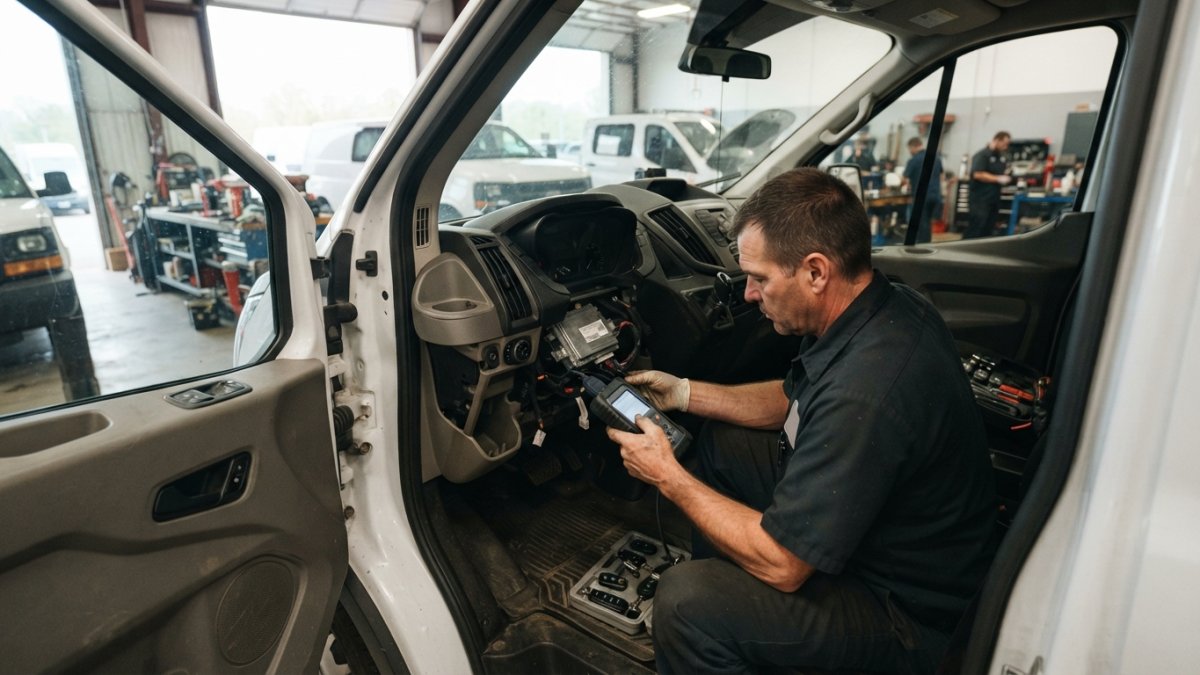
The vehicle networks inside a truck, including CAN bus systems that carry commands between modules, were designed for reliability, not security. A device plugged into the diagnostic port can inject messages. A compromised telematics unit can do the same from a distance.
- Malware and ransomware arriving through a laptop synced to the fleet, or through a malicious mobile app
- Unauthorized access from shared logins and default passwords on telematics portals
- GPS signal manipulation that spoofs location data and misroutes dispatch
- Physical deterrents bypassed when keys and fobs are left in vehicles overnight
Telematics and Vehicle-to-Vendor Communications
Telematics units stream location, speed, and diagnostics to a vendor's cloud. That vendor-to-vehicle link is a high-value target because it is always on and often poorly segmented. Ask your provider how they encrypt data in transit and who can push commands to your units. If the answer is vague, treat the contract as a security finding. The Cybersecurity and Infrastructure Security Agency guidance on securing operational technology is a useful benchmark for the questions to ask.
GPS Signal Manipulation and Location Data Threats
Location data is the quietest asset a fleet owns. Spoofed GPS can send a driver to the wrong address, hide a stolen vehicle from tracking, or falsify hours-of-service records. Location history also reveals customer sites, delivery patterns, and driver routines. Treat route data as sensitive data, restrict who can export it, and set retention limits.
Building Your Vehicle Cybersecurity Checklist
A vehicle cybersecurity checklist turns policy into something a shop supervisor can actually verify. Start with the two controls that stop the most incidents: identity and updates.
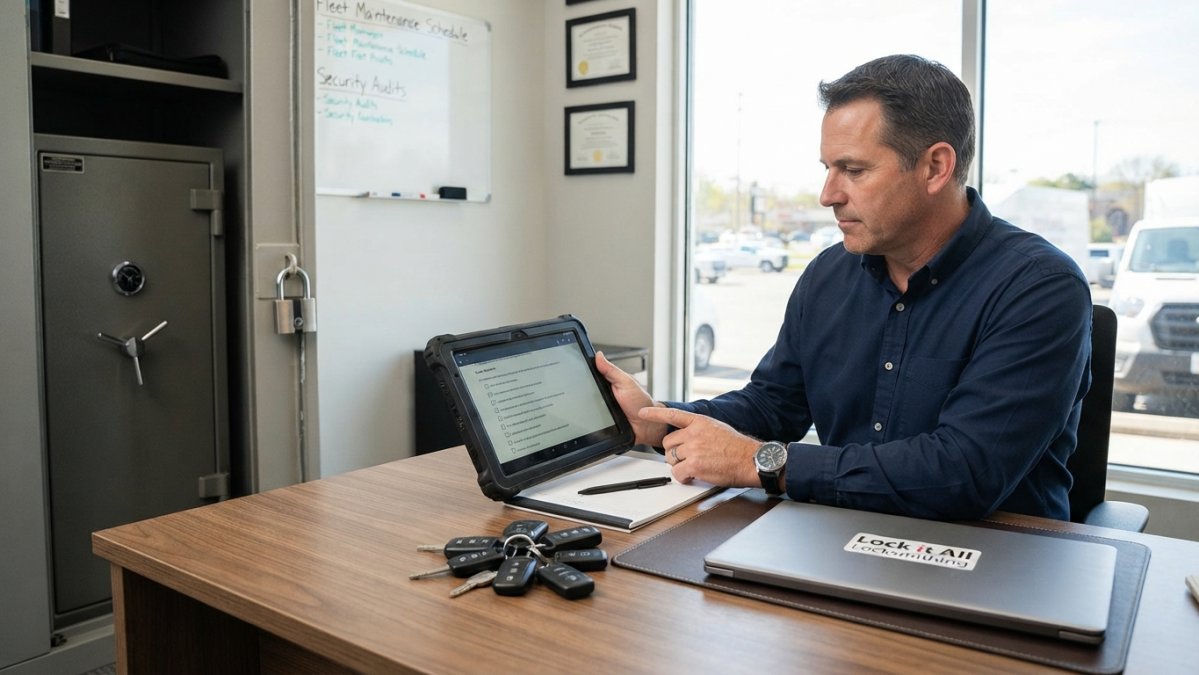
Run through this list quarterly:
- Inventory every connected device, including aftermarket plug-ins
- Confirm multi-factor authentication on all fleet platforms
- Verify firmware versions against vendor bulletins
- Audit user permissions and remove departed staff
- Test that stolen or lost fobs can be revoked
- Review vendor access logs for anomalies
Authentication and Access Control
Strong authentication is the cheapest control you will ever deploy. Require unique passwords through a password manager, enforce multi-factor authentication on telematics and dispatch portals, and never share a dispatcher login across shifts. User permissions should follow least privilege: a driver needs their route, not the ability to disable geofencing.
Physical access control matters just as much. Keys and fobs are credentials. Store them in a controlled cabinet, log issuance, and rekey or reprogram fobs when a vehicle changes hands or a fob goes missing.
Software, Firmware, and Over-the-Air Updates
Over-the-air updates are convenient and dangerous in equal measure. They patch vulnerabilities without a shop visit, but they also give a remote party the ability to change vehicle behavior. Confirm that your vendor signs updates with digital signatures, schedule updates during downtime, and keep a rollback plan. Track firmware versions per vehicle. A unit three updates behind is an open door.
Creating a Fleet Cybersecurity Policy Template
A fleet cybersecurity policy template is a short written document that assigns ownership, sets rules, and defines consequences. Keep it under five pages, or nobody reads it.
Adapt this structure:
- Scope: every vehicle, telematics unit, mobile device, and vendor connection
- Roles: who approves new devices, who holds admin credentials, who leads incident response
- Rules: no personal devices on vehicle networks, no unapproved OBD-II plug-ins, mandatory MFA
- Vendor requirements: security terms in every contract, breach notification timelines
- Training: annual awareness session plus a first-week briefing for new drivers
- Review cadence: policy revisited every year and after any incident
Have drivers sign it. A signed policy changes behavior because it removes the excuse of not knowing.
Securing the Connected Fleet: Governance, Vendors, and EV Charging
Governance is where connected fleet security succeeds or fails. Someone senior must own cyber risk, with a budget and the authority to ground a vehicle. Without that, every control below is optional in practice.
For a broader look at how physical and digital controls fit together across a business, see our overview of security solutions for homes, businesses, and fleet management.
Third-Party Vendor Security and Procurement Controls
Third-party vendors are the largest unmanaged attack surface in most fleets. Telematics providers, maintenance platforms, fuel cards, and mobile app developers all hold credentials into your operation. Procurement should require, in writing:
- A current independent security assessment or audit report
- Breach notification within a defined window
- Data ownership and deletion terms at contract end
- Right to audit and to receive firmware security bulletins
- Named security contact, not a general support line
Vendor security reviews belong in the buying process, not after the invoice.
EV Charging Station and Infrastructure Security
EV charging stations and home chargers add a new class of connected device, and most fleets have no inventory of them. A networked charger is a computer with a power connection. Change default credentials on day one, put chargers on a separate network segment from dispatch systems, and log charging sessions so anomalies stand out. Depot chargers should require authenticated access, and public charging should be treated as untrusted.
Developing a Connected Vehicle Incident Response Plan
A connected vehicle incident response plan is a written playbook that tells staff exactly what to do in the first hour, the first day, and the first week. Detection without response is just monitoring. The unique angle here is operational: most guides stop at "contain and recover," but a fleet playbook has to answer who can ground a truck, how to preserve telematics evidence before it rolls off a vendor's retention window, and what "restored" actually means before a vehicle goes back in service.
Build the playbook around five phases, each with a named owner and a decision authority:
- Detect and triage. Triggers include telematics anomaly alerts, driver reports of unexpected commands or dashboard behavior, vendor breach notices, and help-desk tickets about locked or misrouted vehicles. Triage asks three questions: Is a vehicle moving? Is a driver at risk? Is the fleet management platform itself compromised? A platform compromise escalates immediately because every vehicle behind that platform is in scope.
- Contain. Revoke credentials first, then disable remote commands, then immobilize affected vehicles through the telematics provider or a physical immobilizer. Isolate the vehicle network by pulling aftermarket OBD-II devices and quarantining any laptop or tablet that synced with the fleet. If the telematics vendor's cloud is the suspected entry point, ask the vendor to suspend command-push capability fleet-wide until the scope is known.
- Preserve evidence. Before you wipe, reflash, or reissue anything, capture the telematics event log, command history, login audit trail, firmware versions, and the physical device serial numbers. Vendor portals often retain logs for a limited window, so export early and store copies outside the affected environment. Photograph aftermarket devices and ports before removal. Chain-of-custody notes matter if law enforcement, an insurer, or counsel later needs the record.
- Notify. Sequence matters. Internal: response lead, operations, safety, legal, and communications. External: insurer, counsel, the telematics or software vendor, and, depending on what data was exposed, affected customers, drivers, and regulators. Breach-notification deadlines vary by state and by contract, so the playbook should name who makes the call and which outside counsel to dial, not leave it to be figured out mid-incident.
- Recover and verify. Restore from clean backups, confirm firmware against vendor bulletins, reissue fobs and credentials, and re-run the authentication and permission audit before any vehicle returns to service. Define a written return-to-service checklist so recovery is a gate, not a guess.
Name a response lead and a backup, and give both the authority to ground vehicles without waiting for a committee. Keep a printed contact sheet, because your incident may take down the systems that hold the numbers. Run a tabletop exercise at least annually, a two-hour walkthrough of a spoofed-GPS or ransomware scenario exposes gaps that a written plan hides. Vehicle immobilizers and physical deterrents remain useful containment tools when digital access is uncertain.
Fleet Cybersecurity Metrics and Maturity Assessment
Fleet cybersecurity metrics make progress visible to people who sign budgets, and a maturity assessment tells you where to spend the next dollar. Most guides give you a checklist and stop. The unique angle here is a scored baseline with a prioritized remediation plan and measurable milestones, so you can show a board or an insurer that the program is moving.
Start with a small set of metrics you can actually collect from systems you already run. Report them monthly and trend them quarter over quarter.
| Metric | What It Measures | Target Direction |
|---|---|---|
| Vehicles on current firmware | Patch discipline | Rising |
| Median patch latency (days from vendor bulletin to fleet install) | Update speed | Falling |
| Accounts with MFA enabled | Authentication coverage | Toward full coverage |
| Unresolved high-severity vulnerabilities | Exposure backlog | Falling |
| Unapproved devices found per audit | Asset inventory accuracy | Falling |
| Mean time to revoke access | Offboarding speed | Falling |
| Vendor assessment coverage (share of vendors reviewed) | Procurement control | Rising |
| Mean time to contain an incident | Response maturity | Falling |
| Incidents and near misses | Detection maturity | Tracked, not hidden |
Pick no more than six to start. A metric nobody can collect is worse than no metric, because it teaches the team that reporting is theater.
A Scored Maturity Baseline
Score each control area on a simple five-level scale: 1 = ad hoc, 2 = documented, 3 = enforced, 4 = measured, 5 = continuously improved. Score these areas separately: asset inventory, authentication and access, patch and firmware management, telematics and vendor security, incident response, training, and privacy and data retention. Have the fleet manager, an IT representative, and a shop supervisor score independently, then reconcile. The spread between their scores is itself a finding, it usually means the policy exists on paper but not on the floor.
A common pattern is a fleet that scores 3 or 4 on authentication because MFA is on, but 1 or 2 on asset inventory because aftermarket plug-ins were never counted. The lowest score is not always the right place to spend first. Prioritize by risk exposure times ease of fix: a missing asset inventory undermines every other control, while a training refresh is cheap and fast. A practical order is inventory, then authentication, then patch discipline, then vendor controls, then incident response, then privacy governance.
Measurable Milestones
Turn the baseline into dated commitments. Examples of the shape these take: complete a full connected-device inventory within one quarter; reach full MFA coverage on telematics and dispatch portals within two quarters; cut median patch latency by half within two quarters; review every vendor holding fleet credentials within one year. Re-score annually and after any incident. The re-score is the proof the program is managed rather than aspirational.
Privacy, Data Retention, and Employee Monitoring
Privacy and security share the same data. Location tracking, camera footage, and driver behavior scoring all create legal and ethical obligations. Electronic monitoring of employees is subject to notice requirements that vary, so check your state's requirements with counsel. Check your state's requirements with counsel, and put the monitoring policy in writing.
Set retention limits per data type. Route history rarely needs to live forever, and old location data is pure liability. Restrict exports to named roles, log every export, and delete on schedule. Drivers who understand what is collected and why are far more likely to report anomalies instead of working around the system.
Next Steps for Securing Your Fleet Vehicles
The hardest part of fleet cybersecurity is not technology. It is accepting that the key in a driver's pocket is a network credential, and treating it with the same care as an admin password.
Start this month with three moves: inventory every connected device, turn on multi-factor authentication, and change every default password. Then write the policy and name an owner. Progress compounds from there.
Lock it All Locksmithing supports the physical side of that program with expert car key replacement, key fob programming, and remote start installation for modern vehicles, plus commercial access control for business properties. For specifics on the services available and current pricing, contact the team directly.
Get started with Lock it All Locksmithing and close the physical gaps in your fleet security this quarter. Call 615-810-7304.
Frequently Asked Questions
What are the biggest cybersecurity risks for connected fleet vehicles?
The biggest risks include unauthorized access through weak authentication, telematics system breaches, GPS signal manipulation, and malware introduced via mobile apps or software updates. Ransomware and data theft targeting sensitive location and operational data are also rising. Fleet managers should prioritize strong authentication, regular software updates, and vendor security assessments to reduce these risks.
How can fleet managers protect vehicle telematics systems from cyberattacks?
Protect telematics by enforcing multi-factor authentication for all users, using unique passwords, and segmenting vehicle networks from other business systems. Ensure telematics units receive firmware updates promptly and monitor for unusual data transfers. Vendor contracts should include security requirements and incident notification clauses. A vehicle cybersecurity checklist helps verify these controls are in place.
What cybersecurity policies should a fleet have for connected vehicles?
A fleet cybersecurity policy should cover access control, password management, software update schedules, incident response procedures, and vendor risk management. It should also address driver responsibilities, data retention, and EV charging security. Using a fleet cybersecurity policy template ensures all critical areas are documented and reviewed regularly.
How should a fleet respond to a suspected vehicle cyberattack?
A connected vehicle incident response plan should include immediate steps: isolate the affected vehicle, disable remote access, preserve logs, and notify your security team and vendor. Document the incident, assess impact, and follow recovery procedures. Regular drills and clear communication channels help minimize downtime and data loss.
How can fleet managers secure vehicle software updates?
Secure software updates by verifying digital signatures, using encrypted connections, and scheduling updates during downtime. Require vendors to provide authenticated over-the-air update mechanisms. Maintain an asset inventory of firmware versions and test updates on a small group before fleet-wide rollout to catch issues early.
What role do drivers play in connected vehicle cybersecurity?
Drivers are the first line of defense. Train them to recognize phishing attempts, avoid connecting unauthorized devices, and report unusual vehicle behavior. Enforce strong authentication and unique passwords for mobile apps. Drivers should also follow protocols for physical security, such as using vehicle immobilizers and reporting lost keys promptly.


Why Nashville drivers choose Lock it All Locksmithing
We are a locally owned, licensed and insured mobile locksmith serving Nashville, Antioch, Brentwood, Franklin, Smyrna, La Vergne, Murfreesboro, Hermitage and Mt. Juliet. You speak directly with the technician who does the work, get an honest price before we dispatch, and we arrive in a fully stocked service vehicle so most jobs finish in a single visit — usually within 20 to 45 minutes of arriving. No towing, no dealership appointment, no surprise fees.
How the visit works
- Tell us the details: call, text or send the quote form with your vehicle's year, make and model, or a description of your lock problem.
- Get an exact price: we quote parts, cutting, programming and travel up front.
- We come to you: our mobile workshop meets you at home, work or roadside.
- Done on the spot: keys are cut, programmed and tested with you before we leave.
Areas we serve
Nashville, Antioch, Brentwood, Franklin, Smyrna, La Vergne, Murfreesboro, Hermitage and Mt. Juliet. If you're outside these areas, call 615-810-7304 to confirm whether we can help.
What our customers say
Best locksmith in town excellent service and great price !!
— Adrian Fiorito, 5 stars.Very wonderful service, strong quality, great prices, and it does not take long.
— George Yacoub, 5 stars.Great customer service - Professional - Fast Highly recommend.
— Jan Daoud, 5 stars.
Rated 5 stars across 100+ verified Google reviews. Call or text 615-810-7304 or email info@lia-locksmith.com.