Commercial Door Lock Maintenance Tips: A 2026 Guide
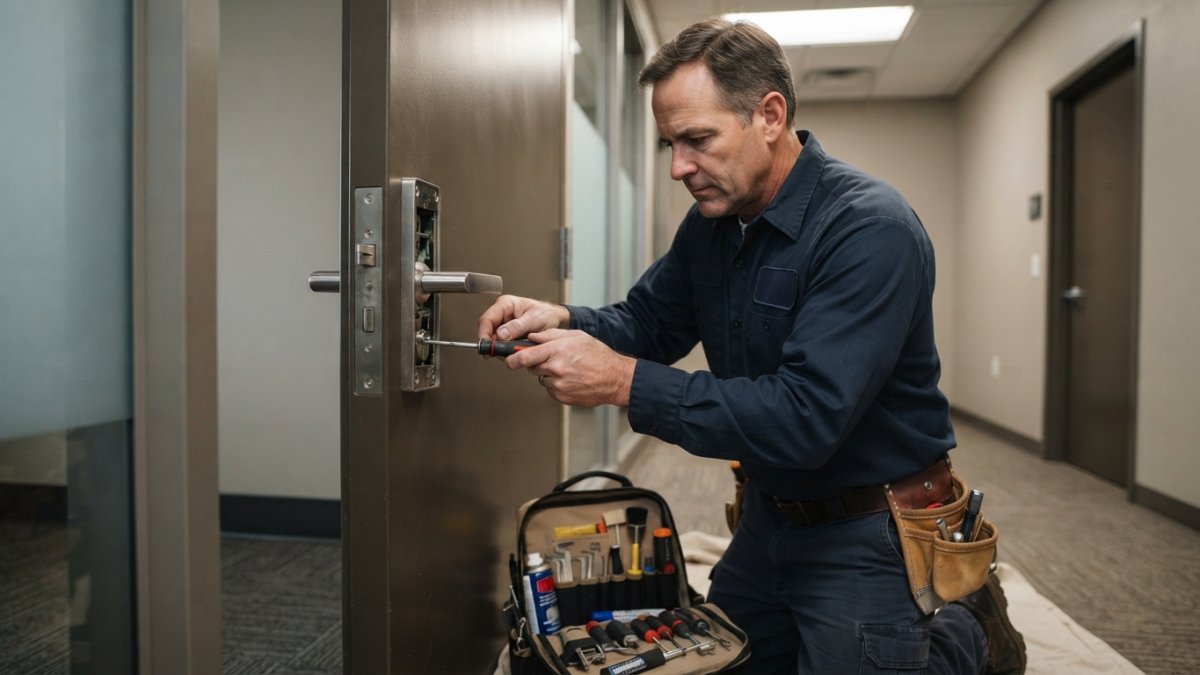
Keep your commercial door lock working smoothly with these maintenance tips. Learn inspection, lubrication, and troubleshooting steps for lasting security.
Last Updated: October 23, 2026
Quick Summary
Clean and lubricate your commercial door lock on a set schedule, using dry graphite or PTFE dry film in cylinders and silicone on latches and hinges, and inspect monthly for sticking keys, loose handles, and uneven door-to-frame gaps. Match the schedule to the hardware type, since panic bars, mortise locks, and electronic locks each wear differently.
- Run a monthly walk-through of 5 to 10 minutes per door to test keys, latches, and handles.
- A one- to two-second burst of lubricant into a keyhole is plenty for a cylinder.
- Avoid heavy grease and cooking oil, which trap grit and jam springs and pins.
- Replace hardware if you have called a technician for the same lock twice in a year.
- Electronic locks need quarterly battery and firmware checks plus an annual full audit.
Table of Contents
- Why Commercial Door Lock Maintenance Matters
- Your Commercial Lock Maintenance Checklist
- Commercial Door Lock Inspection: What to Look For
- Commercial Door Lock Lubrication Done Right
- Commercial Lock Troubleshooting: Common Problems and Fixes
- When to Repair vs. Replace Commercial Door Hardware
- Frequently Asked Questions
Why Commercial Door Lock Maintenance Matters
A commercial door lock is the metal assembly that secures a business entrance, controls who gets in, and takes more daily abuse than any lock in a building. According to Occupational Safety and Health Administration guidance on exit routes and door hardware, doors along exit routes must open freely without keys or special knowledge, which means a sticking lock is not just an annoyance.
At Lock it All Locksmithing, we get called out to commercial properties where a lock failed for one boring reason: nobody ever touched it. Locks wear quietly. Springs weaken, cylinders dry out, and hinges sag until the door stops lining up with the frame.
The good news is that commercial door lock maintenance tips are simple to follow. A short monthly routine prevents most failures.
Below, we'll show you exactly what to check, what to lubricate, and when to call a pro.
Your Commercial Lock Maintenance Checklist
A commercial lock maintenance checklist turns guesswork into a repeatable routine, but a single generic schedule underserves a building with mixed hardware. A cylindrical storeroom lock, a mortise lock on a main entrance, a panic bar on an egress door, and an electronic access lock each fail in different ways and need different intervals. Use the schedule below as a starting point, then adjust based on traffic and exposure.
Hardware-specific maintenance intervals
| Hardware type | Inspect | Clean | Lubricate | Deep service |
|---|---|---|---|---|
| Mechanical cylindrical lock (storeroom, entry) | Monthly | Monthly | Quarterly | Annually |
| Mortise lock (main entrance, suite doors) | Monthly | Quarterly | Quarterly | Annually |
| Panic hardware / exit devices | Monthly | Quarterly | Quarterly | Annually, plus after any alarm event |
| Electronic access lock (keypad, card, fob) | Monthly | Quarterly | Per manufacturer | Quarterly battery and firmware check; annual full audit |
| Door closers and hinges | Monthly | Quarterly | Quarterly | Annually |
High-traffic entrances, exterior doors, and doors exposed to weather should move up one interval. A rear service door that sees fifty cycles a day does not need the same schedule as a supply closet that opens twice a week.
What each interval should include
Monthly walk-through (5-10 minutes per door). Test key or credential operation, watch the latch engage the strike plate, listen for dragging or rubbing, and look for loose handles, hinges, or mounting screws. Note anything that felt different from last month.
Quarterly service (15-20 minutes per door). Clean keyholes and lock bodies, apply lubricant per the section below, check door-to-frame gaps on all sides, test closers for closing speed and latching, and inspect weatherstripping for tears or compression loss.
Annual deep service. A technician should remove covers where applicable, inspect internal springs and cams, check strike plate and frame screw torque, test panic hardware for full release, and verify electronic locks against the manufacturer's diagnostic routine.
Electronic lock checks in the same routine
Electronic and access-control locks belong on the same log, but with their own line items: battery level or low-battery warning, credential test with a known-good card or fob, audit-log review for unusual access attempts, firmware version check against the manufacturer's current release, and a fail-safe versus fail-secure test to confirm the lock releases as designed during a power loss. These checks are quick, but skipping them is how a building ends up with a lock that works fine until the day it does not.
Keep a maintenance log
Record the date, door identifier, hardware type, tasks performed, and any pass/fail result. A log does two things a memory cannot: it shows a pattern when the same door keeps failing, and it gives a technician a service history before they arrive. If a lock fails the same check twice in a row, escalate it rather than resetting the clock.
Commercial Door Lock Inspection: What to Look For
A commercial door lock inspection is a slow, hands-on look at every part of the door hardware, not a quick jiggle of the handle. Start with the key. Does it turn smoothly, or does it catch halfway?
Next, look at the lock mechanism and keyhole. Shine a light inside for rust buildup, corrosion, or debris. Then check the latch. It should snap into the strike plate without force.
Move on to the handle and hinges. A loose handle means loose screws. A hinge with rust or a bent pin throws the whole door leaf out of line.
Finally, check the door-to-frame gap. Run a finger or a thin card around the door. The gap should be even on all sides.
Commercial Door Lock Lubrication Done Right
Commercial door lock lubrication is where most well-meaning maintenance goes wrong. People spray whatever is in the supply closet into the keyhole, and a few weeks later the lock is worse. The product matters, the amount matters, and the mechanism matters.
Match the lubricant to the mechanism
| Mechanism | Suitable lubricant | Avoid |
|---|---|---|
| Mechanical cylinder (pin tumbler) | Dry graphite or a PTFE-based dry film | Heavy grease, cooking oil, WD-40 as a long-term fix |
| Mortise lock body | Silicone spray or dry film on moving parts | Grease that collects dust in the case |
| Latches and strike plates | Silicone spray, light coat | Thick grease that holds grit |
| Hinges | Light machine oil or silicone | Graphite, which can stain and migrate |
| Door closers | Manufacturer-specified hydraulic fluid only | Any spray lubricant in the hydraulic circuit |
| Electronic locks | Manufacturer-specified product only | Anything not approved, which can void coverage |
A dry film or graphite product is the safer choice inside a cylinder because it does not hold dust. Silicone works well on latches, hinges, and closer arms. Heavy grease and cooking oil trap grit, and over time they turn into a paste that jams springs and pins. General-purpose spray lubricants are not lock lubricants; they can leave a residue that attracts debris.
How much to apply
Less is more. A one- to two-second burst into a keyhole is plenty for a cylinder. Work the key in and out several times to spread the product, then wipe away any excess so it does not attract dust. On hinges and latches, a light coat is enough; a visible drip means you used too much. Over-lubrication is a common cause of sticky latches and stained door faces.
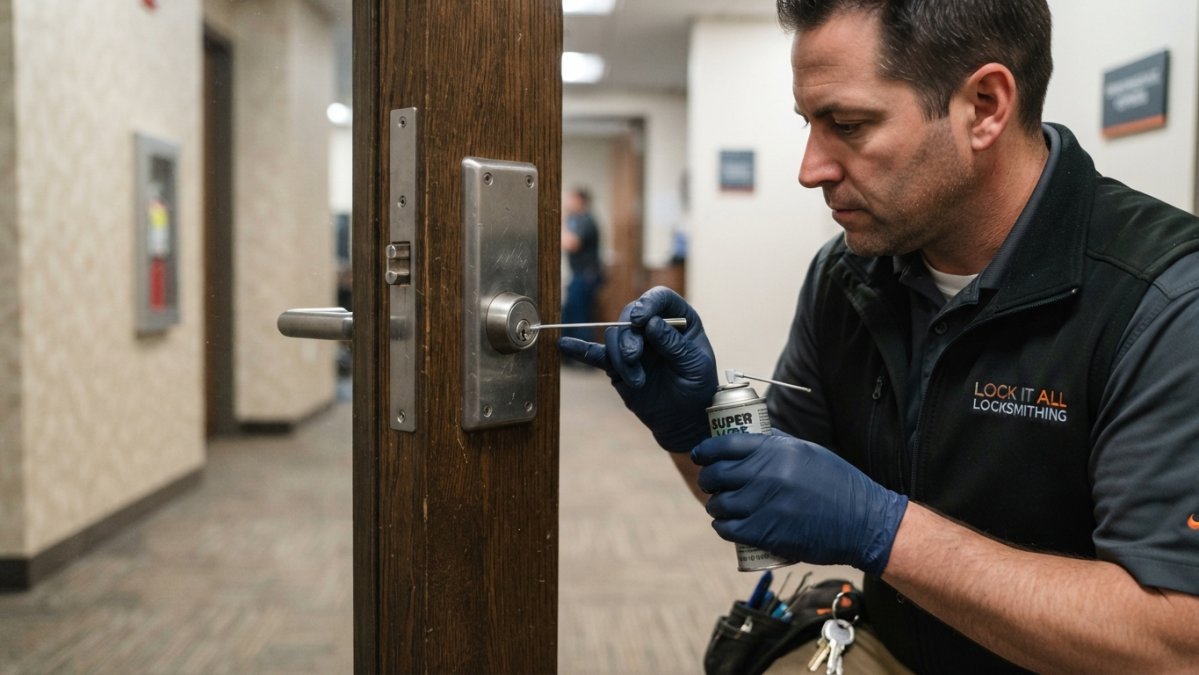
Step-by-step application
- Wipe the keyhole and surrounding hardware clean first.
- Shake the lubricant can well.
- Use the straw to give a short burst into the keyhole. One or two seconds is plenty.
- Work the key in and out several times to spread it.
- Wipe away any excess so it does not attract dust.
- Apply a light coat to hinges and the latch, not a flood.
Cautions that prevent callbacks
Do not mix lubricant types in the same cylinder; graphite and silicone can combine into a gummy residue. Do not spray lubricant into an electronic lock's credential reader or battery compartment. If a lock has been over-lubricated and is now collecting debris, a technician may need to flush and re-lubricate the cylinder rather than adding more product.
Commercial Lock Troubleshooting: Common Problems and Fixes
Commercial lock troubleshooting starts with one question: is the lock itself broken, or is something around it out of line?
The key sticks or will not turn. Try a small amount of silicone lubricant first.
The latch will not catch. Check the strike plate. Loose screws or a shifted plate are common causes. Tighten or adjust the plate before assuming the lock is dead.
The door drags or rubs the frame. This is a door alignment problem, not a lock problem. Check hinges for wear and tighten the frame screws.
The lock feels loose or wobbly. Loose mounting screws are usually the culprit. Tighten them, but do not overtighten and strip the holes.
Electronic or access-control locks misbehave. Many models can be fixed with a factory reset or reprogram, but always check the manufacturer's instructions first.
When to Repair vs. Replace Commercial Door Hardware
Repair usually wins when the hardware is sound and the problem is adjustment. Replace when the metal itself is worn, rusted through, or failing repeatedly.
Here is how we think about it:
- Repair if the issue is lubrication, a loose screw, a misaligned strike plate, or a door that needs realigning.
- Repair if the lock is a few years old and works well after a tune-up.
- Replace if the cylinder is worn out, the springs are weak, or corrosion has eaten into the mechanism.
- Replace if you have called a technician for the same lock twice in a year.
- Replace if you are upgrading to access control or a higher-security lock.
If you are weighing new hardware, our guide to smart lock vs traditional deadbolt security breaks down the tradeoffs before you commit.
For anything beyond a basic adjustment, a trained technician can diagnose the root cause and tell you honestly whether repair or replacement makes more sense. That is the kind of work we handle at Lock it All Locksmithing, alongside commercial access control and high-security lock installation.
Frequently Asked Questions
How often should commercial door locks be inspected?
Inspect high-traffic commercial doors monthly and lower-traffic doors quarterly. Check for loose hardware, sticking keys, and visible wear. A formal inspection by a trained technician every six to twelve months catches alignment issues and internal wear before they cause failures. Document each inspection with date, findings, and actions taken to build a maintenance log that supports budgeting and warranty claims.
What lubricant is safe for commercial door lock cylinders?
Use a dry lubricant such as graphite or a silicone-based spray specifically labeled for lock cylinders. Avoid oil-based products like WD-40, which attract dirt and can gum up the lock mechanism over time. Apply sparingly, then work the key in and out several times to distribute the lubricant. For latches, hinges, and closers, use a manufacturer-recommended grease or silicone spray. Always check compatibility with the lock manufacturer's guidelines.
Why is my commercial door lock difficult to turn?
A sticking lock often results from a misaligned door or frame, debris in the keyhole, or a worn cylinder. First, check the door-to-frame gap and hinge tightness. Clean the keyhole with compressed air and apply a dry lubricant. If the key still binds, the cylinder may be worn or the door may need realignment. Persistent problems warrant a professional inspection to avoid damaging the lock further.
How do I know when a commercial lock needs to be replaced?
Replace the lock when keys require jiggling to work, the cylinder feels loose, or you notice visible corrosion or cracked hardware. Frequent lockouts or keys breaking in the cylinder also signal replacement. For electronic locks, persistent error codes or failure to reprogram after a factory reset indicate it is time for a new unit. A trained technician can assess whether repair or replacement is more cost-effective.
A commercial door lock that fails during business hours costs you time, money, and peace of mind. The fix is rarely complicated: inspect monthly, lubricate correctly, and fix alignment problems before they wreck the hardware. When a lock needs real attention, Lock it All Locksmithing can inspect, repair, or replace your commercial door hardware and set up access control that fits your building. Call 615-810-7304 to get started and keep your doors secure and working smoothly.

Why Nashville drivers choose Lock it All Locksmithing
We are a locally owned, licensed and insured mobile locksmith serving Nashville, Antioch, Brentwood, Franklin, Smyrna, La Vergne, Murfreesboro, Hermitage and Mt. Juliet. You speak directly with the technician who does the work, get an honest price before we dispatch, and we arrive in a fully stocked service vehicle so most jobs finish in a single visit — usually within 20 to 45 minutes of arriving. No towing, no dealership appointment, no surprise fees.
How the visit works
- Tell us the details: call, text or send the quote form with your vehicle's year, make and model, or a description of your lock problem.
- Get an exact price: we quote parts, cutting, programming and travel up front.
- We come to you: our mobile workshop meets you at home, work or roadside.
- Done on the spot: keys are cut, programmed and tested with you before we leave.
Areas we serve
Nashville, Antioch, Brentwood, Franklin, Smyrna, La Vergne, Murfreesboro, Hermitage and Mt. Juliet. If you're outside these areas, call 615-810-7304 to confirm whether we can help.
What our customers say
Best locksmith in town excellent service and great price !!
— Adrian Fiorito, 5 stars.Very wonderful service, strong quality, great prices, and it does not take long.
— George Yacoub, 5 stars.Great customer service - Professional - Fast Highly recommend.
— Jan Daoud, 5 stars.
Rated 5 stars across 100+ verified Google reviews. Call or text 615-810-7304 or email info@lia-locksmith.com.