Upgrading Commercial Door Hardware for Better Security
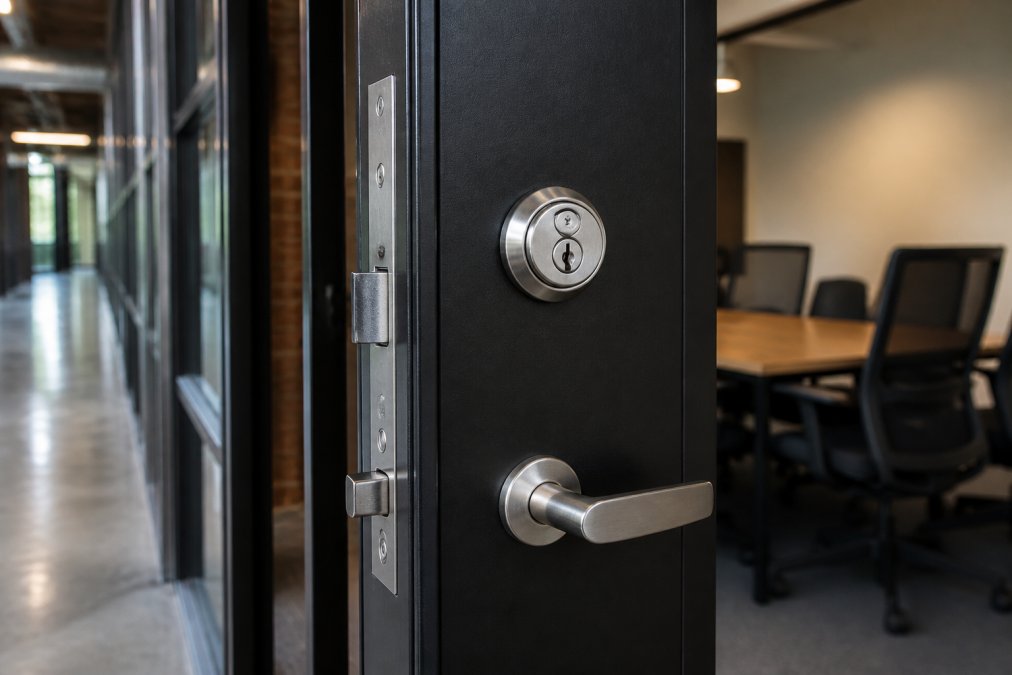
Upgrading commercial door hardware for better security starts with the right locks, frames, and access control. Learn what to prioritize and what to skip.
Table of Contents
- Start With a Vulnerability Assessment, Not a Shopping List
- Commercial Door Hardware Standards ANSI/BHMA: What the Grades Actually Mean
- High-Security Cylinders and Deadbolts That Resist Picking and Bumping
- Reinforcing the Door Frame, Strike Plate, and Hinges
- Benefits of Electronic Access Control Systems for Commercial Buildings
- ADA Compliance for Commercial Door Hardware: What You Cannot Overlook
- Maintenance, Lifecycle Planning, and BMS Integration
- Frequently Asked Questions
Last Updated: September 18, 2026
Start With a Vulnerability Assessment, Not a Shopping List
Upgrading commercial door hardware for better security starts with understanding how your doors can actually be defeated, not with browsing catalogs. At Lock it All Locksmithing, we see the same pattern repeatedly: business owners buy premium locksets while the frame behind them flexes under a pry bar. A vulnerability assessment is the diagnostic step that prevents that waste.
Walk every exterior door and note four things: the lock type, the door material, the frame condition, and how the door is used daily. A rear service door propped open for deliveries all day needs different hardware than a vault room accessed twice a week.
Prioritize findings by realistic risk. Forced entry, unauthorized key duplication, and lost credentials top the list for most commercial properties. The ANSI/BHMA standards overview gives you a shared vocabulary for grading whatever you eventually buy.
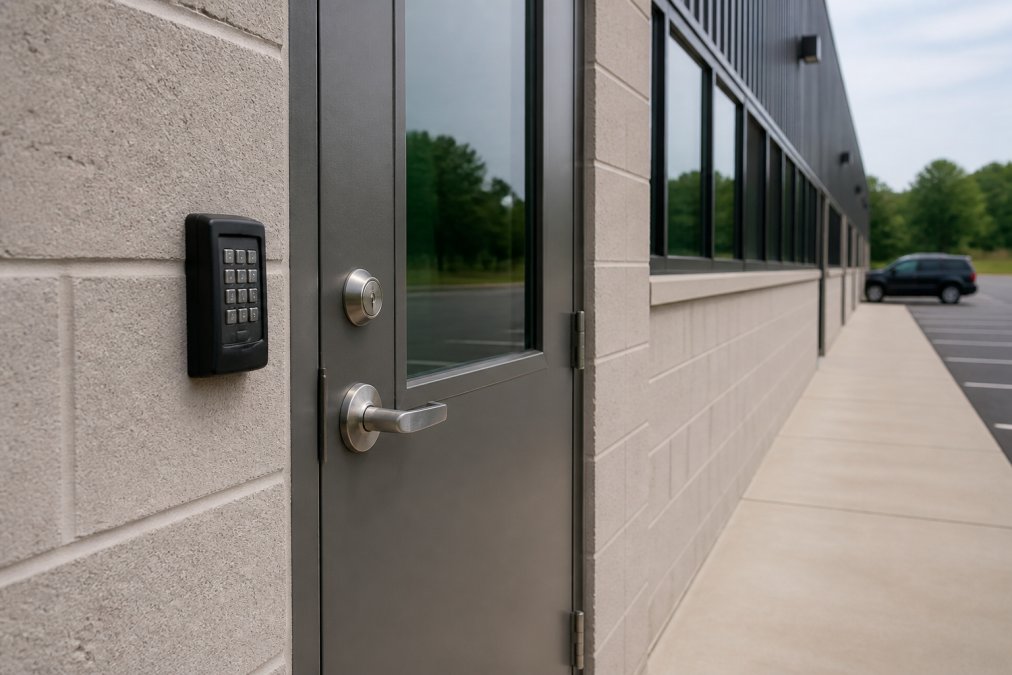
A common mistake is assessing only the lock cylinder. Attackers rarely pick a commercial door when the strike plate screws into a soft frame with half-inch fasteners.
Commercial Door Hardware Standards ANSI/BHMA: What the Grades Actually Mean
Commercial door hardware standards ANSI/BHMA grade locksets on a three-tier scale, and the grade tells you how many cycles the hardware survived in testing. Grade 1 hardware endures the most cycles and abuse, Grade 2 sits in the middle, and Grade 3 is light-duty residential-grade hardware. For most commercial entries, Grade 1 is the correct baseline.
The grading covers more than the lock body. Cylinders, exit devices, hinges, and door closers each carry their own ratings. A Grade 1 deadbolt paired with a Grade 3 closer means the closer fails first and the door stops latching reliably.
| Grade | Typical Use | Cycle Rating (Approx.) | Best For |
|---|---|---|---|
| Grade 1 | Heavy commercial | Highest | Main entries, high-traffic doors |
| Grade 2 | Light commercial | Moderate | Offices, interior suites |
| Grade 3 | Residential / light duty | Lowest | Closets, low-use doors |
What most guides miss is that grade alone does not equal security. A Grade 1 mechanical lockset with a standard cylinder still accepts a duplicated key. Grade tells you durability; cylinder type tells you pick and bump resistance.
High-Security Cylinders and Deadbolts That Resist Picking and Bumping
High-security cylinders are the single highest-return upgrade on most commercial doors because they address the two most common defeat methods: picking and bumping. These cylinders use restricted keyways, security pins, and sidebars that make both attacks impractical.
The second benefit is key control. Restricted keyways require authorization to copy, which shuts down unauthorized key duplication. Many businesses find that lost keys are their biggest unresolved risk, and restricted systems convert that risk into a manageable credential list.
Pair the cylinder with a commercial-grade deadbolt rated for forced entry protection. On steel doors, a deadbolt with a hardened bolt and reinforced strike is a meaningful barrier. On hollow wood or glass doors, the cylinder matters less than the frame reinforcement around it.
Reinforcing the Door Frame, Strike Plate, and Hinges
Door frame integrity decides whether your lock holds under a kick or pry. The strongest cylinder on a weak frame fails in seconds. Reinforcement starts with the strike plate, the metal piece the bolt seats into, and extends to the frame itself.
Three upgrades matter most:
- Replace short strike plate screws with long fasteners that reach the wall studs behind the frame
- Install a heavy-duty strike plate or an astragal-style reinforcement plate
- Add continuous hinges or security hinge pins so the door cannot be lifted off its hinges
Continuous hinges run the full door height and distribute load across the frame rather than at three points. On doors that see heavy daily traffic, they also reduce sag, which keeps the latch aligned and the door closing properly.
The thing nobody tells you about reinforcement is that it changes the failure point. A door with a reinforced frame and a soft lock body now fails at the lock. Upgrade both, or you have moved the problem rather than solved it.
Benefits of Electronic Access Control Systems for Commercial Buildings
Electronic access control systems replace keys with credentials, and the operational benefits usually outweigh the security benefits. The security case is straightforward: lost cards get deactivated in seconds, and you get audit trails showing who entered where and when. The operational case is where electronic systems earn their cost, you stop rekeying the entire building when one employee leaves, and you remove one credential while everyone else keeps working.
What most guides skip is the set of decisions that determine whether the system actually works. Four of them matter more than the brand on the reader:
Fail-safe vs. fail-secure. A fail-safe lock releases when power is lost, which is what you want on an egress door so occupants can always get out. A fail-secure lock stays locked when power is lost, which is what you want on a perimeter door or a server room. Most commercial doors need fail-safe on the inside and fail-secure on the outside, which is why electrified locksets and electric strikes are usually paired with a mechanical override cylinder. If you get this backwards, you either create a life-safety problem or a security hole.
Credential type. Proximity cards (125 kHz) are cheap and common but easy to clone. Smart cards (13.56 MHz, often MIFARE or DESFire) support encryption and are the current baseline for anything handling regulated data. Mobile credentials over Bluetooth or NFC are increasingly common because they eliminate card issuance entirely. Keypads are the cheapest option but share PINs the way mechanical keys get copied. Biometrics solve the lost-credential problem but add enrollment and privacy considerations.
Power and wiring. An electrified lock needs a power transfer at the hinge, either a door loop, a concealed power transfer hinge, or a continuous hinge with integrated wiring. Retrofitting power to a door that was never wired is the single most underestimated cost in an access control project. Battery-powered smart locks avoid the wiring but introduce battery replacement into your maintenance schedule.
Network and head-end. A standalone keypad is not an access control system; it is a keypad. A real system has a controller, a head-end software platform, and a way to push credential changes across doors. Cloud-hosted platforms have made this far more accessible for small facilities, but they require reliable network connectivity at each door and a plan for what happens when the network goes down.
Smart locks, keyless entry, and biometric readers now sit at price points that make sense for small businesses, not just large facilities. A small office can run a keypad entry with scheduled access for far less than the cost of managing mechanical keys across a growing staff.
The trade-off is real: electronic systems need power, network connectivity, and someone who understands the software.
ADA Compliance for Commercial Door Hardware: What You Cannot Overlook
The ADA Standards for Accessible Design spells out the door hardware requirements in detail, and they apply to renovations, not just new construction.
Maintenance, Lifecycle Planning, and BMS Integration
Maintenance and lifecycle planning is where commercial hardware programs succeed or quietly fall apart. Hardware wears out on a predictable schedule, and replacing it reactively costs more than planning for it. Track each door's hardware by installation date and inspect high-traffic doors quarterly.
A simple lifecycle schedule looks like this:
- Inspect closers, hinges, and exit devices every quarter
- Lubricate and adjust moving parts at each inspection
- Replace closers and cylinders on a set interval based on traffic
- Reassess the full door assembly every few years
Frequently Asked Questions
What are the most effective commercial door hardware upgrades for security?
The highest-impact upgrades are a Grade 1 high-security deadbolt or cylindrical lock, a reinforced strike plate with longer screws anchored into the wall stud, continuous hinges that resist door-gap attacks, and an access control system with audit trails. Pairing mechanical hardware with electronic credential management closes the gaps that forced-entry attempts target most: the frame, the strike, and the hinge side. A vulnerability assessment tells you which of these your building actually needs first.
Can I upgrade commercial door security without replacing the entire door?
Yes, in most cases. You can retrofit high-security cylinders into existing locksets, add door reinforcement plates and continuous hinges, upgrade the strike plate, and install electronic access control on the existing frame. The door slab itself usually stays. The exceptions are fire-rated door assemblies: if you drill or modify the door or frame, you may void its fire rating and need a labeled replacement. Check the door's certification label before any modification.
What is the difference between Grade 1 and Grade 2 commercial door hardware?
ANSI/BHMA grades reflect cycle testing and durability. Grade 1 hardware is tested to the highest cycle counts and is built for high-traffic entrances like schools, hospitals, and retail main doors. Grade 2 is tested to a lower cycle count and suits lighter-traffic interior or secondary doors. Grade 3 covers residential and light commercial use. For a main entrance that sees hundreds of openings per day, Grade 1 is the standard to specify.
How does smart access control integrate with traditional commercial door hardware?
Electronic access control replaces the key cylinder as the primary credential check but keeps the mechanical lock body, closer, and exit device. You install an electrified lock or a strike that releases on a valid credential, wire it to a controller, and manage permissions through software. The mechanical hardware still handles egress and fire-rated door requirements. This lets you keep existing doors, add audit trails and keyless entry, and integrate with a building management system if one is in place.
Why Nashville drivers choose Lock it All Locksmithing
We are a locally owned, licensed and insured mobile locksmith serving Nashville, Antioch, Brentwood, Franklin, Smyrna, La Vergne, Murfreesboro, Hermitage and Mt. Juliet. You speak directly with the technician who does the work, get an honest price before we dispatch, and we arrive in a fully stocked service vehicle so most jobs finish in a single visit — usually within 20 to 45 minutes of arriving. No towing, no dealership appointment, no surprise fees.
How the visit works
- Tell us the details: call, text or send the quote form with your vehicle's year, make and model, or a description of your lock problem.
- Get an exact price: we quote parts, cutting, programming and travel up front.
- We come to you: our mobile workshop meets you at home, work or roadside.
- Done on the spot: keys are cut, programmed and tested with you before we leave.
Areas we serve
Nashville, Antioch, Brentwood, Franklin, Smyrna, La Vergne, Murfreesboro, Hermitage and Mt. Juliet. If you're outside these areas, call 615-810-7304 to confirm whether we can help.
What our customers say
Best locksmith in town excellent service and great price !!
— Adrian Fiorito, 5 stars.Very wonderful service, strong quality, great prices, and it does not take long.
— George Yacoub, 5 stars.Great customer service - Professional - Fast Highly recommend.
— Jan Daoud, 5 stars.
Rated 5 stars across 100+ verified Google reviews. Call or text 615-810-7304 or email info@lia-locksmith.com.