What to Do When Locked Out of Office: Steps to Get Back In
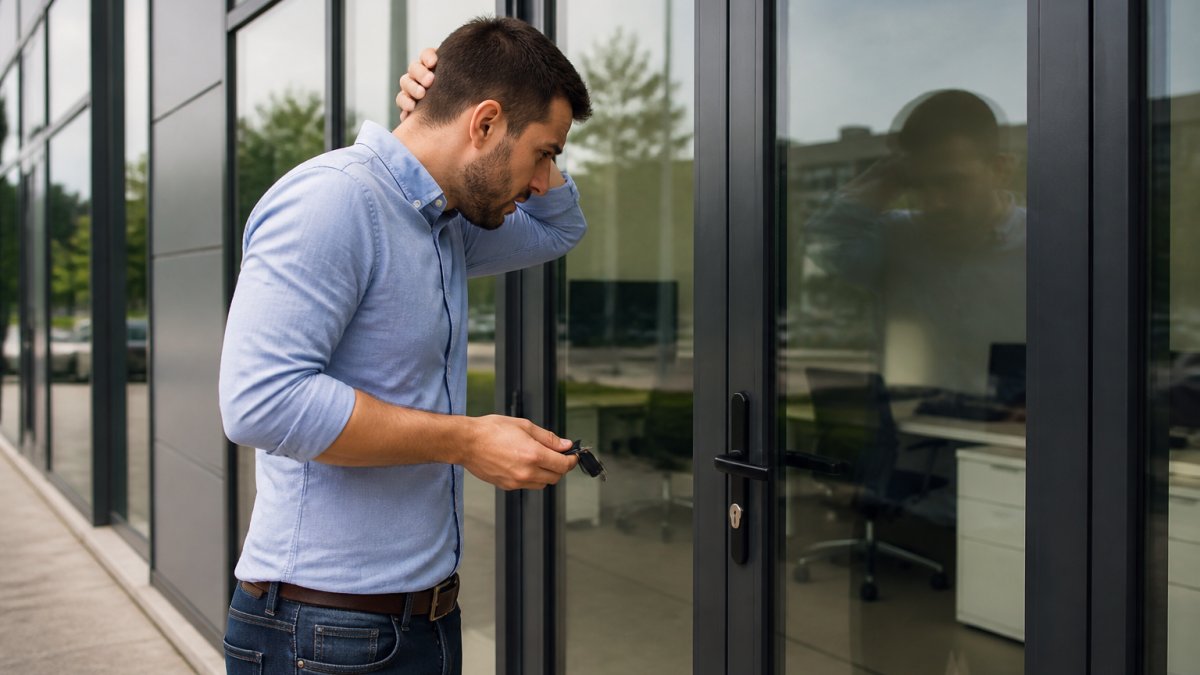
Locked out of office? Learn step-by-step what to do, from checking alternate entry points to calling emergency commercial locksmith services safely.
Table of Contents
- Stay Calm and Assess the Situation Before You Act
- Check for Alternate Entry Points and Access Options
- Contact Building Management, Security, or a Coworker With a Spare Key
- When to Call Emergency Commercial Locksmith Services
- What Locksmith Response Time and Pricing to Expect
- Digital and Smart Lock Troubleshooting for Modern Offices
- Preventing Office Lockouts: Access Control and Backup Plans
- Frequently Asked Questions
Last Updated: October 1, 2026
Stay Calm and Assess the Situation Before You Act
Ask yourself three quick questions:
- Is the door actually locked, or just stuck?
- Do you have any other way in today?
- Is anyone else inside who could let you in?
Once you've confirmed the door is locked, move to the next step.
Check for Alternate Entry Points and Access Options
A locked front door rarely means the whole building is sealed. Most offices have more than one way in, and one of them is probably open.
Walk the perimeter and check every entry point:
- Side or rear doors used for deliveries
- A loading dock or service entrance
- A connected stairwell or shared hallway
- Windows that open from inside
- A rooftop or garage access door
Contact Building Management, Security, or a Coworker With a Spare Key
The fastest way back inside is usually a person, not a tool. Before you call anyone, work through the people who already have authorized entry.
Start with these contacts:
- Building management or the property manager. They often hold a master key or a key card for your suite.
- Building security. A guard on site may have access or a log of who else can let you in.
- Your office administrator or office manager. They usually track spare keys and access codes.
- A coworker with a spare key. Even one person with a key solves the problem in minutes.
- Your landlord or leasing agent. For smaller offices, they may be the only keyholder.
When to Call Emergency Commercial Locksmith Services
Call emergency commercial locksmith services when no one with a key can reach you, when the lock itself is broken, or when waiting puts your business at risk. That's the point where a professional saves you time and money.
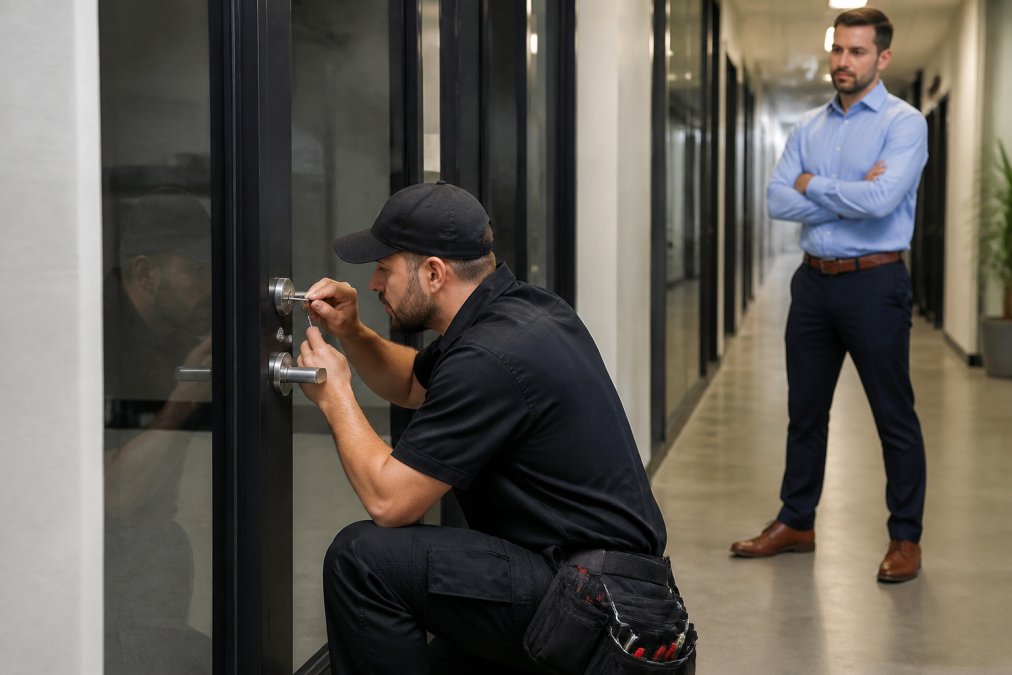
Here's when a call makes sense:
- No spare key exists or no keyholder can get there
- The lock is jammed, broken, or damaged
- You have clients, deliveries, or appointments waiting
- Sensitive data or equipment needs to be secured fast
- It's after hours and no one else can help
- The door is the only entry and the building has no on-site staff
The liability angle most guides skip
Forcing a commercial door yourself isn't just a repair risk, it's a legal and financial one. Three things usually happen when you pop a lock or pry a frame on your own:
- Your lease may make you pay for it. Most commercial leases in the U.S. put repair costs for tenant-caused damage on the tenant, and some treat any unauthorized alteration to the premises as a default event. A bent strike plate or cracked frame can trigger a repair charge plus a lease violation notice.
- Your property insurance may not cover it. Standard commercial property policies typically exclude damage from improper entry or "faulty workmanship." A licensed locksmith's invoice, by contrast, is often a covered loss or a reimbursable maintenance expense because the work is performed by a bonded trade professional.
- You may create a security event. If you leave the door visibly damaged or propped while you wait, you've arguably failed your own duty to secure the premises, which can matter if something is stolen afterward.
The sensitive-data problem
If your office holds client records, medical information, financial data, or regulated equipment, an uncontrolled entry is a compliance issue, not just a convenience issue. A broken window or a pried door leaves the space open while you wait for a repair. A locksmith opens the door, relocks it behind you, and leaves the perimeter intact.
What to have ready when you call
A locksmith can move faster if you give them the right information up front:
- Your business name, suite number, and full street address
- The type of lock (deadbolt, mortise, cylindrical, electronic keypad, or access-controlled)
- Whether the door is glass, hollow metal, or solid core wood
- Whether anyone is inside
- Your ID and proof of tenancy or employment
What Locksmith Response Time and Pricing to Expect
Locksmith response time and pricing vary by location, time of day, and the type of lock. That's the honest answer, and it's why you should ask about both before you agree to anything. But "it depends" isn't useful when you're standing in a parking lot at 7 a.m. Here's what the numbers actually look like.
Response time
For a standard business-hours commercial lockout in a metro or suburban area, a realistic window is 30 to 60 minutes from the time you call. Rural areas and after-hours calls commonly run 60 to 120 minutes. Weekend and holiday calls can stretch longer because fewer technicians are on rotation.
What drives the price
Commercial lockout pricing is built from a few components:
- Service call fee, a flat charge to get the technician to your door, typically the base of the bill
- Labor, billed per hour or as a flat lockout rate, higher after hours and on weekends
- Parts, only if a cylinder, keypad, or hardware needs replacing
- Travel, some companies charge per mile outside a service radius
These are ranges, not quotes. The only number that matters is the one the dispatcher gives you for your specific address, lock type, and time of day.
Questions to ask before you book
Get the quote in writing or by text. That protects you if the final bill doesn't match. A legitimate company will put the service call fee and the lockout rate in writing before dispatch.
Red flags to watch for
- A quote that's dramatically lower than everyone else's, followed by a much higher bill on arrival
- A refusal to give a total price over the phone
- A technician who arrives in an unmarked vehicle with no license or insurance information
- Pressure to drill or replace a lock before trying non-destructive entry
- Cash-only demands
Many states require locksmiths to be licensed, and some require a state-issued license number on the invoice. Ask for it. If the company can't produce one, that's your answer.
What "licensed and insured" actually buys you
A licensed, insured locksmith carries general liability coverage and, in many states, a surety bond. If they damage your door or frame during entry, that coverage is what pays for the repair, not you. An unlicensed operator has no such backstop, and your own insurer may decline the claim because the work wasn't performed by a qualified trade professional.
Digital and Smart Lock Troubleshooting for Modern Offices
Smart locks and electronic keypads fail in ways a traditional deadbolt never does. Before you call anyone, run through the common fixes. Many lockouts are a dead battery or a dropped connection, not a broken lock.
Try these steps first:
- Replace the batteries. A dying keypad or smart lock often goes dead without warning.
- Check the app. Your access system may show a lock status or let you unlock remotely.
- Try a backup code. Many electronic keypads have a master code or a physical key override.
- Reboot the lock. Some smart locks reset with a quick power cycle.
- Test a second fob. If one key fob fails, another may still work.
Preventing Office Lockouts: Access Control and Backup Plans
Preventing office lockouts comes down to one idea: never let a single point of failure lock your whole team out. A little planning now saves a lot of stress later.
Build these habits into your routine:
- Set up a master key system. One key opens the doors you choose, so management always has access.
- Keep a spare key with a trusted person. A coworker, landlord, or nearby business works well.
- Store a backup code or physical key securely. Not under the mat, but somewhere only staff can reach.
- Assign key fobs and codes to specific people. Track who has what.
- Test your locks and keypads monthly. Catch a dying battery before it strands you.
- Post an emergency contact list. Include building management and a locksmith you trust.
Frequently Asked Questions
What should I do first if I'm locked out of my office door?
Stop and check whether the door is actually locked or just stuck, then look for alternate entry points like a side entrance or loading dock. If you're in a shared building, contact building management or security before calling anyone else. If you're alone after hours with no on-site staff, call emergency commercial locksmith services and be ready to show ID proving you have authorized entry to the space.
Should I call a locksmith or building security when locked out of office?
Start with building security or the property manager if your office is in a managed building, since they often hold a master key or key fob and can let you in at no cost. Call a locksmith when no one with access is reachable, when it's after hours, or when the lock itself is broken. A locksmith can verify your identification and security clearance before opening the door, which protects you legally.
How long does a locksmith usually take to arrive for an office lockout?
Locksmith response time varies by location, time of day, and how busy the dispatcher is. When you call, ask for a specific arrival estimate and confirm whether the quoted service call fee covers the on-site assessment, so there are no surprises.
Can I break into my own office door to avoid paying a locksmith?
Forcing entry yourself risks property damage to the door frame, deadbolt, or electronic keypad, and your insurance coverage may not pay for damage you caused intentionally. If the space holds sensitive data or valuables, a botched forced entry can also trigger liability issues with your landlord or employer. Let a professional handle the lock mechanism instead of prying or drilling it yourself.
A lockout is stressful, but it rarely has to end in a broken door or a lost workday. With a spare key plan, the right contacts, and a locksmith you trust, you can get back inside fast and keep your business secure. Lock it All Locksmithing offers commercial access control, high-security lock installations, and expert lock service for offices across Tennessee. Get started with Lock it All Locksmithing and turn a lockout into a five-minute fix. Call 615-810-7304.
Why Nashville drivers choose Lock it All Locksmithing
We are a locally owned, licensed and insured mobile locksmith serving Nashville, Antioch, Brentwood, Franklin, Smyrna, La Vergne, Murfreesboro, Hermitage and Mt. Juliet. You speak directly with the technician who does the work, get an honest price before we dispatch, and we arrive in a fully stocked service vehicle so most jobs finish in a single visit — usually within 20 to 45 minutes of arriving. No towing, no dealership appointment, no surprise fees.
How the visit works
- Tell us the details: call, text or send the quote form with your vehicle's year, make and model, or a description of your lock problem.
- Get an exact price: we quote parts, cutting, programming and travel up front.
- We come to you: our mobile workshop meets you at home, work or roadside.
- Done on the spot: keys are cut, programmed and tested with you before we leave.
Areas we serve
Nashville, Antioch, Brentwood, Franklin, Smyrna, La Vergne, Murfreesboro, Hermitage and Mt. Juliet. If you're outside these areas, call 615-810-7304 to confirm whether we can help.
What our customers say
Best locksmith in town excellent service and great price !!
— Adrian Fiorito, 5 stars.Very wonderful service, strong quality, great prices, and it does not take long.
— George Yacoub, 5 stars.Great customer service - Professional - Fast Highly recommend.
— Jan Daoud, 5 stars.
Rated 5 stars across 100+ verified Google reviews. Call or text 615-810-7304 or email info@lia-locksmith.com.