How to Secure a Sliding Glass Door: 2026 DIY Guide
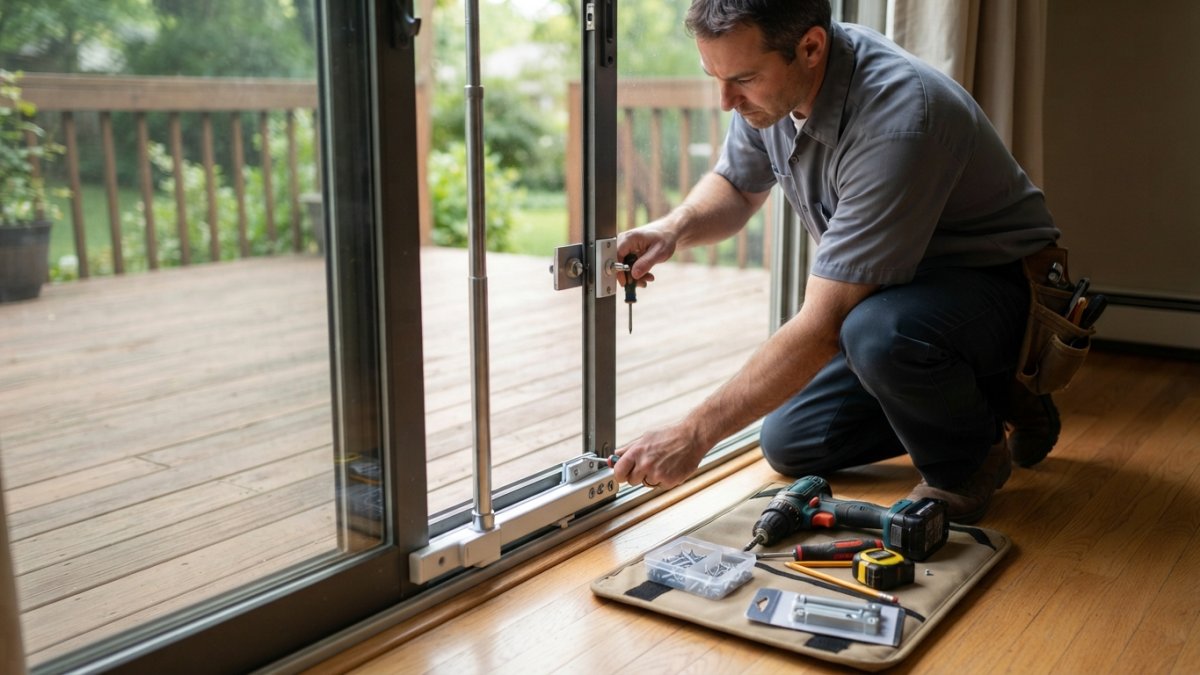
Learn how to secure a sliding glass door with anti-lift devices, track blockers, and lock upgrades. A step-by-step DIY guide for stronger home security.
Table of Contents
- Why Sliding Glass Doors Are a Prime Target for Break-Ins
- How to Secure a Sliding Glass Door: Step-by-Step
- Choosing the Right Sliding Glass Door Security Bar
- Installing a Sliding Door Auxiliary Lock
- How to Lock a Sliding Door Without a Lock
- Using a Sliding Glass Door Anti-Lift Device
- Rental-Friendly and Low-Cost Security Upgrades
- Conclusion
- Frequently Asked Questions
Last Updated: October 13, 2026
Why Sliding Glass Doors Are a Prime Target for Break-Ins
Forced entry through a patio door rarely involves smashing glass. It usually means prying, lifting, or popping a weak latch in seconds.
Sliding glass door security means reinforcing the lock, blocking the track, and preventing the door from being lifted out of its frame.
The FBI crime data on burglary shows most break-ins happen through ground-floor doors and windows. Your patio door is right at the top of that list.
How to Secure a Sliding Glass Door: Step-by-Step
Securing a sliding glass door takes about 30 to 60 minutes per door: reinforce the lock, block the track, and stop the door from lifting.
What you'll need:
- Screwdriver and drill with a 1/8-inch and 1/4-inch bit
- Tape measure
- Security bar or track blocker
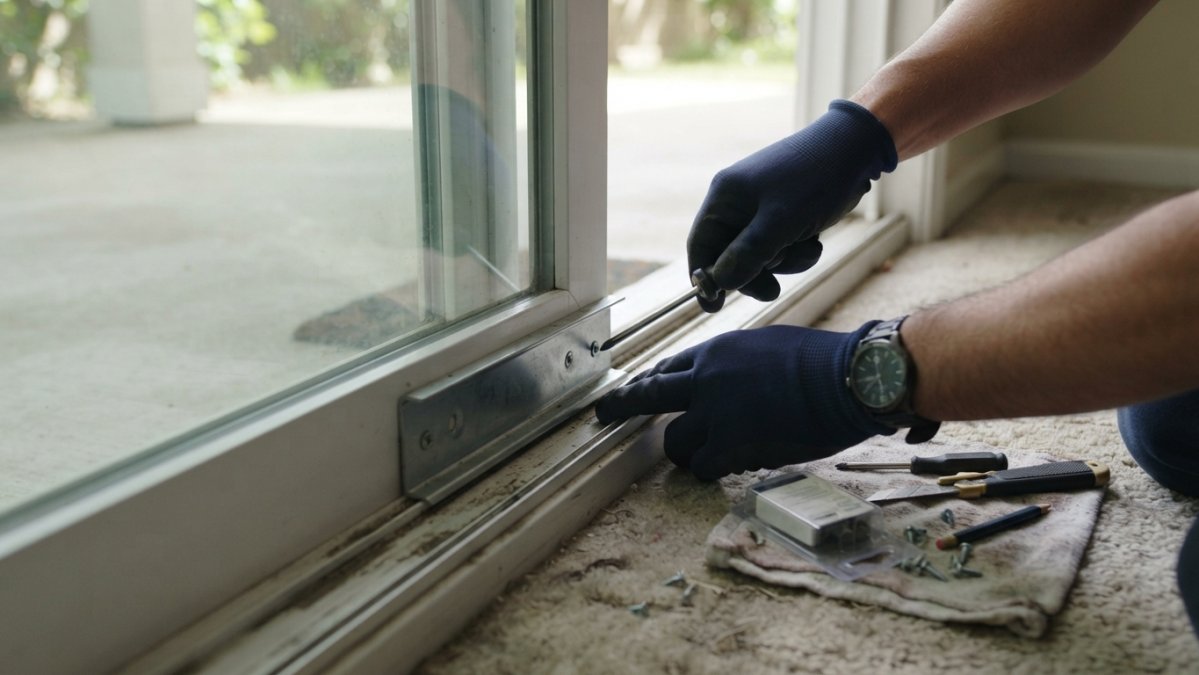
Step 1: Assess Your Door Before You Buy Anything
Most failed installs happen because someone bought a device that didn't fit. Before you spend a dollar, identify four things:
1. Track type and width. The bottom track is either a single raised rail or a flat channel. Measure the inside channel width with the door closed, most residential tracks are 1 to 2 inches. A track blocker must sit inside that channel without binding the door; narrow tracks or raised center rails need a bar with a notched or grooved base.
2. Door material and frame. Vinyl, aluminum, and wood take screws differently. Vinyl can crack near an edge, drill a pilot hole and stay 1/2 inch from any edge.
3. Latch style. Mortise-style latches sit in a pocket cut into the door stile; surface-mount latches screw onto the face.
4. Lift gap. Close the door, grab the handle, and lift straight up.
Write these four measurements down. Every device below is chosen based on them.
Step 2: Reinforce the Lock and Latch
Tighten or replace the existing latch first, a loose latch defeats every other upgrade.
For real protection, add a secondary lock. A keyed auxiliary lock or pin lock drills into the frame and jamb, stopping the door from sliding open even if the main latch fails. Choose a pin lock for the simplest, most tamper-resistant option; a keyed lock if you need outside access.
Step 3: Block the Track and Prevent Lifting
A track blocker or security bar sits in the bottom track and stops the door from sliding, the single most effective low-cost upgrade.
For lift prevention, install an anti-lift device or add shims above the upper track. On doors with a large lift gap, a top-track blocker screwed into the upper track is more reliable than shims, which can be dislodged.
| Weak Point | Fix | Why It Works |
|---|---|---|
| Loose latch | Tighten or replace; upgrade strike screws | Restores basic lock function and resists prying |
| Sliding track | Track blocker or bar | Physically blocks the door |
| Lift-off gap | Anti-lift device or top-track blocker | Stops the door leaving the track |
| Single-pane glass | Security film or grille | Slows glass breakage |
| Soft or rotten jamb | Replace jamb section before mounting hardware | Hardware can't hold in soft wood |
Step 4: Test Everything Before You Call It Done
After installation, run through this check:
- Close and latch the door. It should seat without force.
- Try to slide the door open with the bar in place. It should not move.
- Lift the door. It should not rise more than 1/8 inch.
- Lock and unlock the auxiliary lock three times. It should engage smoothly every time.
- Open the door fully and confirm the bar or blocker doesn't scrape the track.
If any step fails, adjust before moving on. A device that binds the door or fails to engage is worse than no device, because it gives false confidence.
Never install a fixed bar or lock that prevents the door from opening from the inside. In an emergency, that door may be your only exit. Every device in this guide can be removed or unlocked from inside in seconds, verify that before you rely on it.
Choosing the Right Sliding Glass Door Security Bar
A sliding glass door security bar is a metal or wood rod that sits in the bottom track and stops the door from sliding open even if the latch is defeated. It's the cheapest, most reliable upgrade you can make, but only if it fits your track.
Measure Before You Buy
Two measurements matter, and most buyers skip both.
1. Track channel width. With the door closed, measure the inside width of the bottom channel where the bar will sit.
2. Opening length. With the door closed, measure from the inside edge of the fixed panel's frame to the inside edge of the jamb on the sliding side, the maximum bar length.
Write both numbers down. Between sizes, size up on diameter and down on length, a slightly short bar can be shimmed, but one that's too long won't let the door close.
Match the Bar to Your Track Type
Not every bar works in every track:
- Flat channel track: A standard round or square bar with rubber ends grips the channel and prevents scratching.
- Raised center rail track: The bar must straddle or sit beside the rail, look for a notched base or flat-bottomed profile; a round bar will roll off.
- Deep or narrow channel: A low-profile bar is required, or a thick bar will bind against the door's bottom rail.
What to Look For
- Adjustable length: Fits different door widths without cutting. Check the range against your opening measurement.
- Rubber or textured ends: Grips the track and won't scratch the frame. Hard plastic ends slide under pressure.
- Thick material: A hollow bar bends; a solid one holds. If you can flex it by hand, it's too thin for security use.
A common mistake is buying a bar that's too short. Measure the track opening with the door closed, then buy one that fits snugly. If it rattles, it's too loose.
Trade-Offs: Bar vs. Charley Bar vs. Dowel
| Option | Strength | Best For | Limitation |
|---|---|---|---|
| Track bar | High | Most sliding doors | Needs correct track fit |
| Charley bar | Medium | Renters, quick install | Wedges under handle; can be defeated if loose |
| Wooden dowel | Low to medium | Backup, budget | Can be cut or broken; needs snug fit |
| Pin lock | High | Permanent install | Requires drilling |
A bar in the track is the strongest no-drill option. A charley bar installs faster but relies on friction against the handle and jamb, so it can work loose. A dowel is a fine backup but shouldn't be your only defense.
Cut a wooden dowel to fit the track as a backup. It costs almost nothing and works when a commercial bar is out of stock. Mark the correct length on the dowel so anyone in the house can re-seat it after cleaning the track.
Maintenance and Testing
A bar only works if it stays seated. Once a month:
- Vacuum or wipe the track, grit under the bar lets it slide.
- Re-seat the bar and try to slide the door. It should not move.
- Check the rubber ends for wear; replace them if compressed or slick.
- Confirm the door still closes fully with the bar in place.
If the door sags or the rollers are worn, the bar may no longer seat at the correct height. Fix the door alignment before relying on the bar, a misaligned door can be lifted over a bar that used to fit.
A security bar is only as good as its fit. Measure the channel width and opening length, match the bar to your track type, and check it monthly. A well-fitted bar stops the door even if every lock fails.
Installing a Sliding Door Auxiliary Lock
A sliding door auxiliary lock is a secondary lock that mounts to the frame and jamb, independent of the main latch. Most install in under 20 minutes with a drill and screwdriver.
Two common types:
- Keyed auxiliary lock: Locks with a key from outside. Good for rentals and back doors.
- Pin lock: A removable pin drops into a hole drilled through the frame. Simple and tamper-resistant.
Installation steps:
- Close the door and mark where the frame meets the jamb.
- Drill a pilot hole through both.
- Insert the lock body and secure with screws.
- Test the lock with the door closed and open.
If you're not comfortable drilling into your frame, a locksmith can install it for you. Lock it All Locksmithing handles residential lock upgrades.
How to Lock a Sliding Door Without a Lock
You can lock a sliding door without a built-in lock using a few simple tricks, good for renters or as a backup.
- Drop a dowel or bar in the track. The door can't slide past it.
- Use a charley bar. A metal bar wedges under the handle and against the jamb.
- Add a pin or nail. Drill a small hole through the frame and drop in a pin.
The dowel-in-track trick is the fastest fix, seconds to install, almost no cost.
The best no-lock solution is a bar in the track. It's simple, cheap, and stops the door from sliding even if every lock fails.
Using a Sliding Glass Door Anti-Lift Device
A sliding glass door anti-lift device stops the door from being lifted off its track, the weakness most homeowners overlook. Sliding doors sit on rollers, so a gap at the top lets an intruder lift the door up and out, bypassing the lock entirely.
Anti-lift devices work in two ways:
- Top-track blockers: Screw into the upper track to limit how high the door can rise.
- Shims or filler strips: Fill the gap above the door so it can't be lifted.
How to check your door for lift risk:
- Close the door fully.
- Grab the handle and lift straight up.
- If the door moves more than a quarter inch, you need an anti-lift device.
This five-minute check is one most people never do. Do it today.
Rental-Friendly and Low-Cost Security Upgrades
Renters can secure a sliding door without damaging the frame. Every fix below is reversible.
- Adjustable security bar: Sits in the track, no drilling.
- Charley bar: Wedges in place, removes in seconds.
- Adhesive security film: Peels off cleanly.
For homeowners, permanent upgrades like a keyed auxiliary lock and anti-lift device offer stronger protection. But even renters can add real layers with no tools and no deposit risk.
A layered approach matters here. One fix slows a burglar. Three fixes send them to an easier target. According to FBI burglary statistics, most burglaries are opportunistic, not planned.
Conclusion
Securing a sliding glass door comes down to three things: reinforce the lock, block the track, and stop the door from lifting. Each layer is cheap, and together they turn a weak point into a hard target.
If you'd rather have it done right the first time, Lock it All Locksmithing can help. We handle residential lock upgrades and auxiliary lock installation.
Call 615-810-7304 to schedule a home security visit.
Frequently Asked Questions
What is the best way to secure a sliding glass door?
The most effective approach is layered protection: upgrade the existing latch to a keyed auxiliary lock, add a sliding glass door security bar or track blocker in the bottom track, and install an anti-lift device at the top. This combination addresses the three common forced-entry methods, prying the latch, sliding the door open, and lifting it off the track. No single product covers all three, so using them together gives you the strongest defense against burglary attempts.
Can you put a security bar on a sliding glass door?
Yes. A sliding glass door security bar sits in the bottom track behind the sliding panel, preventing it from sliding open even if the latch is compromised. Cut the bar to match your track width, typically between 28 and 36 inches for standard doors, and lay it flat in the track. Most bars are removable from the inside, so you can take them out when you need to open the door for ventilation or emergency egress.
How do you lock a sliding glass door without a lock?
If your sliding door has no working lock, you can use a cut-to-size wooden dowel or metal bar in the bottom track to block the panel from sliding. A charley bar, which is a metal bar that wedges between the door frame and the sliding panel, also works without any drilling. For a more permanent solution, a bolt-style auxiliary lock or a keyed patio door lock can be installed on the frame with basic tools.
Do sliding glass door sensors help improve security?
Yes. Glass break sensors and door contact sensors trigger an alarm when the glass shatters or the door opens unexpectedly. They work best as part of a layered system alongside physical barriers like track blockers and auxiliary locks. Sensors alone will not stop forced entry, but they alert you and your monitoring service immediately, which can reduce the time a burglar has inside your home. Pair them with physical reinforcement for the best results.
Why Nashville drivers choose Lock it All Locksmithing
We are a locally owned, licensed and insured mobile locksmith serving Nashville, Antioch, Brentwood, Franklin, Smyrna, La Vergne, Murfreesboro, Hermitage and Mt. Juliet. You speak directly with the technician who does the work, get an honest price before we dispatch, and we arrive in a fully stocked service vehicle so most jobs finish in a single visit — usually within 20 to 45 minutes of arriving. No towing, no dealership appointment, no surprise fees.
How the visit works
- Tell us the details: call, text or send the quote form with your vehicle's year, make and model, or a description of your lock problem.
- Get an exact price: we quote parts, cutting, programming and travel up front.
- We come to you: our mobile workshop meets you at home, work or roadside.
- Done on the spot: keys are cut, programmed and tested with you before we leave.
Areas we serve
Nashville, Antioch, Brentwood, Franklin, Smyrna, La Vergne, Murfreesboro, Hermitage and Mt. Juliet. If you're outside these areas, call 615-810-7304 to confirm whether we can help.
What our customers say
Best locksmith in town excellent service and great price !!
— Adrian Fiorito, 5 stars.Very wonderful service, strong quality, great prices, and it does not take long.
— George Yacoub, 5 stars.Great customer service - Professional - Fast Highly recommend.
— Jan Daoud, 5 stars.
Rated 5 stars across 100+ verified Google reviews. Call or text 615-810-7304 or email info@lia-locksmith.com.