How to Choose High-Security Door Locks for Homes
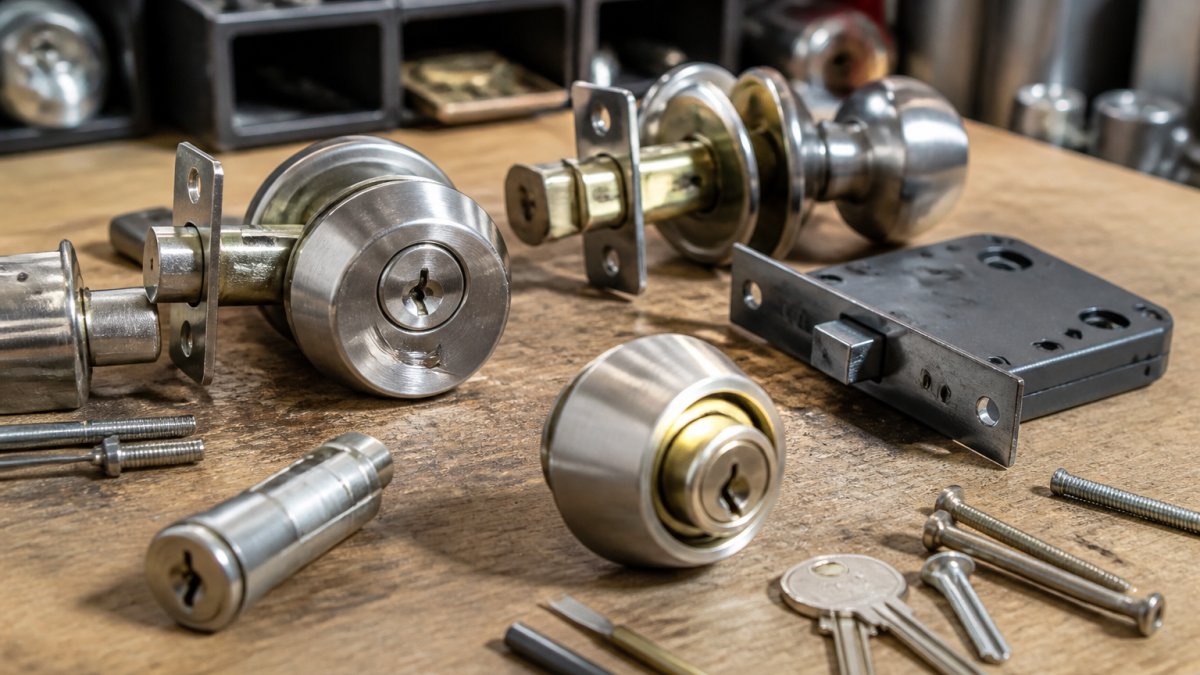
Learn how to select high-security door locks for your home. Compare deadbolts, grades, and smart locks to find the right protection for your needs.
Table of Contents
- Understanding High-Security Door Locks and Why They Matter
- Best Deadbolt Locks for Home Security
- ANSI/BHMA Door Lock Grades: What the Ratings Mean
- Smart Lock vs. Deadbolt Security: Making the Right Choice
- Door Strike Plate Reinforcement and Frame Security
- Selecting the Right Lock for Your Threat Level and Lifestyle
- Frequently Asked Questions
Last Updated: October 14, 2026
Understanding High-Security Door Locks and Why They Matter
High-security door locks are specialized mechanisms designed to resist forced entry, picking, bumping, and drilling. We recommend them for homeowners who want protection beyond standard residential locks.
A standard lock might stop a casual burglar; a high-security lock stops a determined one.
Your front door is your home's first defense, and the lock you choose directly affects how vulnerable you are.
Best Deadbolt Locks for Home Security
A deadbolt is the most important lock on your door, but "deadbolt" is a category, not a guarantee. Two deadbolts can look identical on the shelf and perform completely differently under attack, depending on bolt throw, bolt material, cylinder design, and frame engagement.
How a Deadbolt Actually Resists Attack
A deadbolt fails in one of four ways: the bolt is pried back, sawed or drilled, the cylinder is picked or bumped, or the assembly is ripped out when the frame splits. A high-security deadbolt is engineered against all four.
- Prying. The bolt must extend far enough into the frame that a pry bar can't reach the bolt tip. A 1-inch throw is the practical minimum; many high-security models use a 1-inch hardened bolt with a beveled or free-spinning collar that prevents a saw or wrench from gripping it.
- Sawing and cutting. Standard bolts are mild steel and can be cut with a hacksaw in under a minute. High-security bolts are hardened steel or incorporate a hardened steel insert that resists saw blades and bolt cutters.
- Drilling. Attackers drill the cylinder to reach the pin stack or the bolt-retraction mechanism. High-security cylinders use hardened steel pins, ball bearings, or free-spinning outer rings that spin the drill bit instead of biting.
- Kick-in and frame failure. This is the most common residential defeat, and it has nothing to do with the cylinder. It's covered in the frame-reinforcement section below.
Single-Cylinder vs. Double-Cylinder Deadbolts
Single-cylinder deadbolts have a key cylinder outside and a thumb-turn inside. They're the default for most homes because they allow fast exit in an emergency.
Double-cylinder deadbolts require a key on both sides, defeating the classic "break the glass, reach in, turn the thumb-turn" attack. The trade-off is real: in a fire or medical emergency, you must find and use a key to get out.
For most homes, a single-cylinder deadbolt with a reinforced strike and frame is the better balance. Reserve double-cylinder for doors with glass within arm's reach of the thumb-turn, and only where code allows.
Bolt Throw, Bolt Diameter, and Cylinder Specs to Look For
When you compare deadbolts, look past the finish and check the hardware:
- Bolt throw: at least 1 inch. Anything shorter is easier to shim or pry.
- Bolt diameter: 1 inch is standard; a full 1-inch hardened bolt with a hardened steel roller or insert resists sawing far better than a hollow or case-hardened-only bolt.
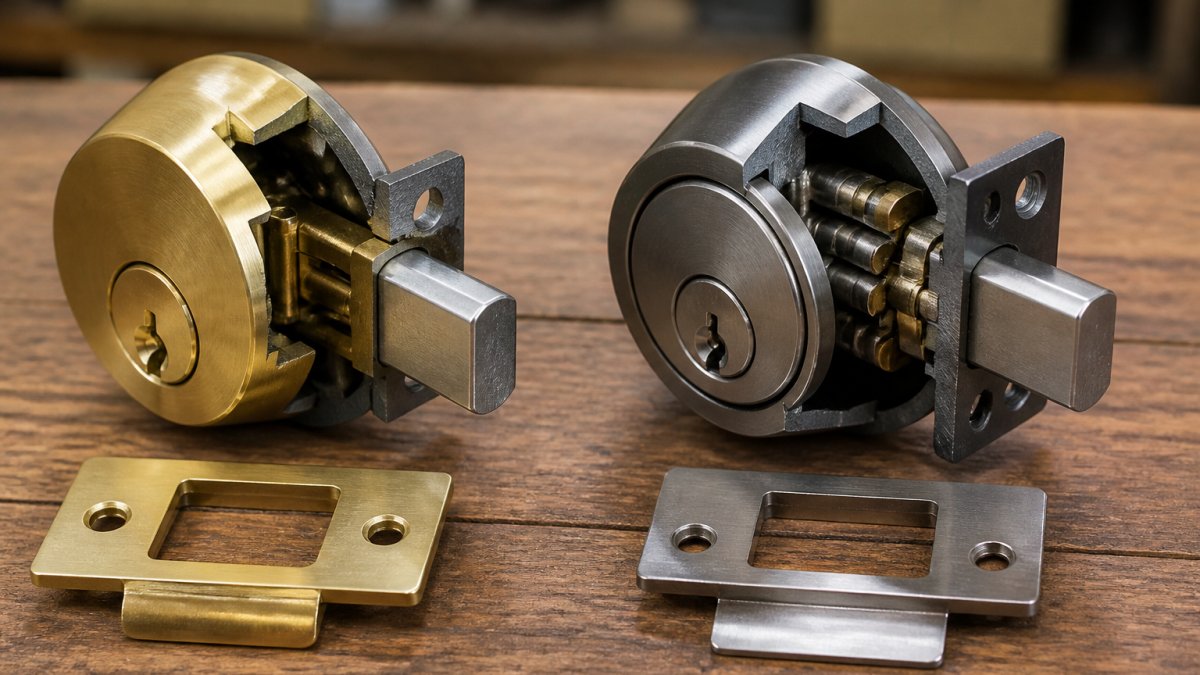
- Cylinder: a solid brass or stainless steel cylinder with a hardened-steel anti-drill plate and anti-pick pins. Avoid pot metal (zinc alloy) cylinders, which deform under torque and can be snapped.
- Faceplate and strike: heavy-gauge steel, not stamped thin metal. The strike is where the bolt meets the frame, and it takes the brunt of a kick.
Deadbolt Materials and Durability
Solid brass and stainless steel are the durable choices. Brass resists corrosion and holds tight tolerances; stainless steel resists deformation and is harder to cut. Both outlast pot metal and thin stamped steel, which corrode, bind, and fail.
A quality deadbolt typically includes:
- A solid brass or stainless steel cylinder
- A hardened steel bolt with at least a 1-inch throw
- A heavy-gauge steel strike plate
- Hardened internal springs and pins
- A cylinder guard or hardened collar
Feel the action: a good cylinder turns smoothly with no grinding or catch. A rough or sticky cylinder signals loose tolerances and cheap internals.
ANSI/BHMA Door Lock Grades: What the Ratings Mean
ANSI (American National Standards Institute) and BHMA (Builders Hardware Manufacturers Association) created a grading system for door locks. There are three grades: 1, 2, and 3. Grade 1 is the strongest; Grade 3 is the weakest.
Grade 1, Grade 2, and Grade 3 Explained
Grade 1 locks are commercial-grade, built for high-traffic environments like office buildings and storefronts, and resist forced entry through multiple attack methods.
Grade 2 locks are mid-range and work well for residential use, resisting common attacks but not specialized ones.
Grade 3 locks are basic, meeting minimum standards but offering limited protection.
The grade rating is based on how the lock performs under specific tests.
Pick, Bump, and Drill Resistance
Pick resistance means the lock is hard to open with picks and tension tools.
Bump resistance refers to protection against bump keys, specially cut keys that can open many locks quickly.
Drill resistance means the lock can withstand drilling attacks. High-security locks use hardened steel and rotating components that break drill bits before the lock fails.
All three resistances matter. A lock that resists picking but not drilling is only half-protected.
Smart Lock vs. Deadbolt Security: Making the Right Choice
Smart locks are convenient, you unlock them with your phone, a code, or biometrics. Traditional deadbolts require a physical key. Which is more secure? Smart locks offer convenience and control; deadbolts offer simplicity and reliability.
Keyless Entry and Access Control
Smart locks let you grant access without handing out keys: temporary codes for contractors, cleaners, or guests, instant revocation when someone moves out, and a log of who entered and when.
The downside: smart locks are electronic.
For primary entry, we recommend a traditional deadbolt. For secondary entry or rental properties, a smart lock can add useful control. Use both together for maximum security and convenience.
Privacy and Cybersecurity Concerns
Smart locks collect data, logging who accessed the door and when, and store it in the cloud, meaning a company has your access history.
Traditional deadbolts have no cybersecurity risk: they don't connect to the internet, store data, or get hacked remotely.
This doesn't mean smart locks are bad. It means you should understand the trade-off. Convenience comes with privacy risk.
Door Strike Plate Reinforcement and Frame Security
A strong lock is only as good as the door frame it's installed in.
Most residential door frames are weak: thin wood, with a strike plate held by short screws that barely bite in.
A reinforced frame stops prying attacks cold. A burglar can't snap a frame held by long screws.
We always recommend frame reinforcement alongside lock upgrades. The best lock in a weak frame is wasted money.
Selecting the Right Lock for Your Threat Level and Lifestyle
Most lock-buying guides tell you to "assess your risk" and stop there. The useful version is a threat-to-hardware map: name the attack you're most likely to face, then buy the feature that defeats it.
Match the Lock to the Threat
| Threat | What it looks like | Hardware that defeats it |
|---|---|---|
| Kick-in / shoulder charge | Door frame splits, strike plate rips out | 3-inch screws through the strike into the stud/header, heavy-gauge strike, reinforced frame |
| Prying | Bar inserted between door and frame | 1-inch bolt throw, beveled or free-spinning bolt collar, tight door/frame gap |
| Picking | Tools manipulate pins through the keyway | Anti-pick pins, security pins (spool/mushroom), restricted keyway |
| Bumping | Bump key jiggled to set pins | Anti-bump pins, sidebar cylinder, restricted keyway |
| Drilling | Power drill destroys the cylinder | Hardened steel pins, anti-drill plate, free-spinning cylinder ring |
| Cylinder snapping | Wrench snaps the cylinder, exposing the mechanism | Cylinder guard / hardened collar, Grade 1 cylinder |
| Code theft / unauthorized entry | Shared or guessed smart-lock codes | Unique per-user codes, auto-expiring guest codes, access logs, two-factor account login |
| Lockout / dead battery | Smart lock fails during outage | Mechanical key override, backup battery, low-battery alerts |
A quiet suburban home is most likely to face a kick-in or pry attempt, so frame reinforcement and a 1-inch hardened bolt matter more than exotic anti-pick pins. A home with glass near the lock should prioritize a double-cylinder deadbolt, subject to egress code. A rental with frequent turnover benefits most from per-user smart-lock codes and access logs.
Budget Considerations
High-security hardware costs more than builder-grade. Expect to pay more for:
- Grade 1 deadbolts than Grade 2 or Grade 3
- Restricted-keyway cylinders than standard keyways
- Smart locks than mechanical deadbolts
- Reinforcement kits and long screws as a small add-on that multiplies the value of whatever lock you buy
The frame-reinforcement kit is usually the highest return per dollar in the whole project. A modest lock in a reinforced frame outperforms an expensive lock in a weak frame.
Installation Checks That Determine Whether the Lock Works
A perfect lock installed wrong is a bad lock. After installation, verify:
- The bolt extends at least 1 inch into the frame when locked.
- The strike plate aligns with the bolt with no gap and no binding.
- The strike is fastened with 3-inch screws that reach through the frame into the wall stud or header, not the short screws that ship in the box.
- The door and frame gap is tight enough that a pry bar can't get purchase.
- The deadbolt is independent of the knob or lever lock, so defeating one doesn't defeat both.
Maintenance and Replacement Signals
Locks are mechanical and they wear. A simple routine keeps them reliable:
- Annually: lubricate the cylinder and bolt with graphite powder or a dry PTFE lubricant. Avoid oil and WD-40, which attract dust and gum up.
- Quarterly: test every lock from both sides, including the key override on any smart lock.
- After any forced-entry attempt: replace the lock, even if it still works. Internal damage may not be visible.
Replace the lock or hardware when you see:
- A key that sticks, grinds, or must be jiggled
- A bolt that doesn't fully extend or retract
- A wobbly cylinder or loose trim
- Visible wear, rust, or deformation on the strike plate
- A smart lock that drops connectivity, misses codes, or no longer logs entries
Frequently Asked Questions
What makes a door lock high security?
High-security door locks combine pick-resistant cylinders, reinforced materials, and tamper-resistant design to resist forced entry, drilling, and bumping. ANSI/BHMA Grade 1 locks meet the highest security standards, with hardened steel components and complex key control that prevents unauthorized duplication. A truly secure installation also includes a reinforced strike plate and solid door frame.
Are deadbolts more secure than standard door locks?
Yes. Deadbolts are significantly more secure because they extend a solid metal bolt into the door frame, making them resistant to pushing, kicking, and prying. Standard knob locks use spring bolts that can be retracted with pressure. For maximum security, choose a Grade 1 deadbolt with a reinforced strike plate and frame. Double-cylinder deadbolts offer extra protection against break-ins through glass panels.
Should I replace the locks when I move into a new home?
Yes. You cannot know who holds copies of the previous owner's keys. Rekeying or replacing locks ensures only you have access. A professional locksmith can rekey existing locks affordably or install new high-security deadbolts. This is especially important for older homes where key control may be compromised.
Are smart locks as secure as traditional deadbolts?
Smart locks offer convenience through keypad and remote access, but security depends on implementation. Quality smart locks include physical deadbolt backup and strong encryption, but they introduce cybersecurity risks if the system is poorly designed or not regularly updated. For maximum security, pair a smart lock with a Grade 1 mechanical deadbolt as a backup, and ensure the lock manufacturer provides regular security patches.
Why Nashville drivers choose Lock it All Locksmithing
We are a locally owned, licensed and insured mobile locksmith serving Nashville, Antioch, Brentwood, Franklin, Smyrna, La Vergne, Murfreesboro, Hermitage and Mt. Juliet. You speak directly with the technician who does the work, get an honest price before we dispatch, and we arrive in a fully stocked service vehicle so most jobs finish in a single visit — usually within 20 to 45 minutes of arriving. No towing, no dealership appointment, no surprise fees.
How the visit works
- Tell us the details: call, text or send the quote form with your vehicle's year, make and model, or a description of your lock problem.
- Get an exact price: we quote parts, cutting, programming and travel up front.
- We come to you: our mobile workshop meets you at home, work or roadside.
- Done on the spot: keys are cut, programmed and tested with you before we leave.
Areas we serve
Nashville, Antioch, Brentwood, Franklin, Smyrna, La Vergne, Murfreesboro, Hermitage and Mt. Juliet. If you're outside these areas, call 615-810-7304 to confirm whether we can help.
What our customers say
Best locksmith in town excellent service and great price !!
— Adrian Fiorito, 5 stars.Very wonderful service, strong quality, great prices, and it does not take long.
— George Yacoub, 5 stars.Great customer service - Professional - Fast Highly recommend.
— Jan Daoud, 5 stars.
Rated 5 stars across 100+ verified Google reviews. Call or text 615-810-7304 or email info@lia-locksmith.com.